

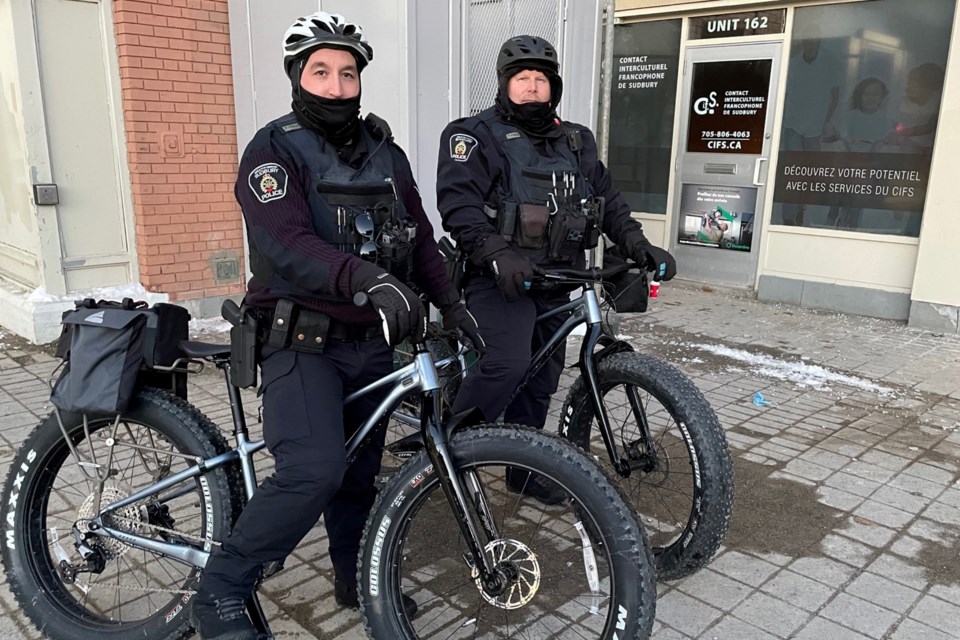
Despite prior comments from Greater Sudbury Police Service Chief Sara Cunningham regarding open drug use no longer being tolerated and arrests forthcoming, only one arrest was made last week.
Nov. 3-7 marked the first week of a month-long crackdown by police, who have been sending enforcement teams to trouble areas from 7 a.m. to 12 a.m.
“We want these individuals to receive support, but we can no longer tolerate this open air drug use and needles all over the downtown,” Cunningham said last month in announcing the crackdown. “It is an offence and we are going to enforce it.”
Thus far, enforcement hasn’t come in the form of arrests, with one recorded during the first week, plus approximately five official warnings, Deputy Chief Natalie Hiltz told Sudbury.com.
“We’d like to say that we’re trying to engage our public, and that includes the addicted public, in trying to make sure there’s an education and awareness piece,” Hiltz said. “We only want to use arrests as a last resort.”
This isn’t a change in course for GSPS, a spokesperson clarified to Sudbury.com, noting, “Decisions are evaluated by officers on a case-by-case basis, taking into account the specific circumstances of each situation.”
Further, while pledging police receptivity to making more arrests for open drug use last month, and even commenting that the federal Crown was on board to ensure charges went through, Cunningham also said they would continue to take a “support first, enforcement last” approach.
A media release issued by police this week notes the initiative “emphasizes diversion over detention, aiming to build trust, reduce harm and foster a healthier downtown environment.”
In the crackdowns first week, there were 72 proactive patrols, 12 occurrences where drug pipes were confiscated, 10 occurrences where other drug paraphernalia was seized (such as tin foil), eight needles collected and 10.2 grams of drugs seized (mostly crack cocaine and fentanyl).
Leading into the November crackdown, Cunningham said that seizing drugs without arrests can lead to additional issues, such as petty crime as people scramble to replenish their supply. It can also contribute to people moving problems to other areas of the city.
This is where Cunningham said arrests would come into play, so people can work substances out of their systems while incarcerated and exit jail “in a good position to be potentially supported.”
Despite this, the first week’s worth of statistics gathered from the downtown crackdown show that police have been seizing drugs without arrests.
Although Hiltz said police have only just completed their first week and are always adapting, it’s unclear from her comments whether their approach will change from their first week now that police’s downtown presence has been established alongside their intent to curb open drug use.
“We are hearing from a lot of community-based sources that there’s certainly a buzz downtown,” Hiltz said. “Everyone is aware that we’re down there, and why we’re down there.
“We’re listening to the public, and we are not interested in criminalizing a public health issue. … It’s about working with our entire community and working with our vulnerable community to change behaviour.”
Every morning begins with a briefing, during which police go over hot spots “as defined by our citizen and public reports,” and officers are dispatched to those areas.
These patrols have been primarily done by police alone thus far, although Hiltz said the Mobile Crisis Rapid Response Teams, in which officers are paired with a Health Sciences North crisis worker to assist in mental health and addictions-related calls, have also been mobilized.
“It’s a slow build,” she said, adding that their ultimate goal is to add various social supports to their patrols, “to build and layer in the expertise and supports of our other partners.”
Despite making only one arrest during the downtown crackdown’s first week, Hiltz said police would continue to share a message that open-air drug use is not permitted downtown, as well as serve as a 24/7 referral service to agencies who can help vulnerable people.
“We’ll see where that goes, but we’re prepared either way,” Hiltz said. “We’re prepared if there are people who are not compliant.”
Police will continue to collect data throughout the month so they can report on the effectiveness of the monthlong crackdown, which police are calling the Supported First Strategy. It is part of a broader effort they’re calling the Project 360° Community Safety framework, which is "designed to reduce open drug use through a compassionate, community-based approach.”
Meanwhile, the city has established a sanctioned encampment site downtown at Energy Court around the old supervised consumption site building, which is being used as a 24/7 warming centre. The city has pledged to ramp up services during the coming months, the specifics of which have yet to be announced.
Local outreach workers have criticized the plan as being half-baked, landing just before the winter freeze. Some fear “mayhem” will ensue in the coming months due in part to there being limited infrastructure and people not getting along with one another.
Tyler Clarke covers city hall and political affairs for Sudbury.com.