

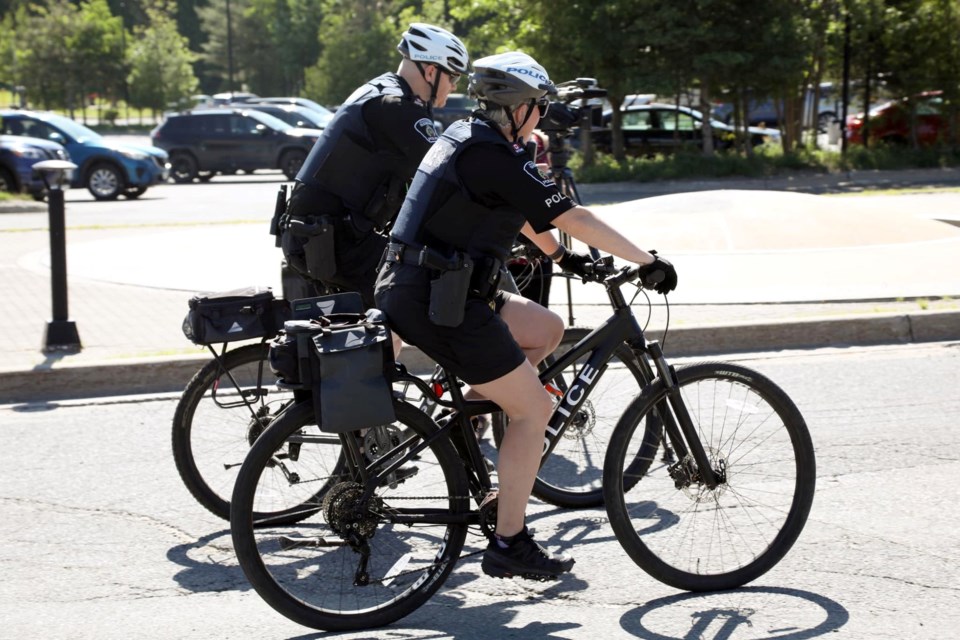
Declaring, “We will no longer tolerate open drug use,” Greater Sudbury Police Service Chief Sara Cunningham announced a November crackdown on the “wicked” downtown problem.
Cunningham announced the plan during Wednesday’s police board meeting, after which she shared additional insights with local journalists.
It’s a nuanced issue extending well beyond the jurisdiction of police, she clarified repeatedly during her scrum with journalists and the board meeting itself.
“It’s a health crisis we’re not going to enforce our way out of,” she said, adding that at the same time, police must play a role, and that in some situations, “enforcement might be the best option.”
“Public Health plays a really crucial role in our open-air drug crisis, but it does not diminish the role of the police to intervene when necessary,” Cunningham said.
Police have been taking a “not here, not now” approach to addressing open drug use in the city’s downtown core, she said, which has had its merits to an extent. This approach has seen police push drug users toward community support rather than jail cells.
While this “support first, enforcement last” approach will continue to take place, Cunningham pledged an additional step for those who decline help.
“We're going to seize drugs where appropriate and we’re going to enforce where appropriate,” she said.
“Where appropriate” will be determined on a case-by-case basis at officers’ discretion, Cunningham said, clarifying that people who are repeatedly seen using drugs will be the most likely to face enforcement.
Although police have been seizing drugs on occasion, she said this approach can cause additional issues. While drug users seek to replace their supply, they can resort to such things as petty crime. Meanwhile, Cunningham said that enforcement without arrests can contribute to moving the problem to other areas of the city.
The hope is that by arresting people, they’ll work substances out of their systems while incarcerated and exit jail “in a good position to be potentially supported,” Cunningham said.
Police will be notified when drug users are released from jail, at which point they’ll be educated on what services are available, such as transitional housing.
This extra step, Cunnigham said, is “where we’ve dropped the ball for some time.”
Cunningham said police have connected with representatives within the local legal system to ensure there’s capacity and support in police efforts.
“We have full commitment from our federal Crown, Jacob Gautier,” she said.
Police are kicking off this more aggressive approach to policing downtown with a concerted effort throughout the month of November, during which an enforcement team will operate through downtown from 7 a.m. to 12 a.m.*
“It’s in response to a problem that did not happen overnight, so we’re definitely not going to rectify it overnight, but it’s an initiative to start to put the message out that it’s no longer going to be tolerated,” Cunningham said.
“We want these individuals to receive support, but we can no longer tolerate this open air drug use and needles all over the downtown. It is an offence and we are going to enforce it.”
Word of an added police presence should “spread like wildfire,” she said, also clarifying during Wednesday’s meeting that the effort would be on top of an increased footprint they already established earlier this year. She would not ascribe a number to the number of police involved in these efforts.
A crackdown on drug dealers will take place using “covert and undercover” strategies.
Meanwhile, police are joining the city in creating a panhandling strategy to help prevent what Deputy Chief Natalie Hiltz described as “risky, dangerous behaviour on roadways.”
This includes panhandling at intersections, where people are often seen weaving and out of traffic to collect donations.
Although Mayor Paul Lefebvre pledged a tougher stance on panhandling during a Rotary Club luncheon on Oct. 2, this is not the direction police are taking.
Police have long said that enforcement doesn’t cut to the root cause of panhandling, and they’ve long taken an approach of moving along panhandlers rather than charging them, despite the provincial Safe Streets Act prohibiting certain acts of panhandling, including at intersections.
Further, Cunningham said that when panhandlers are moved along by police, either they quickly return or someone else takes their place.
Instead, a public education campaign will discourage people from donating to panhandlers. It will also promote that donations go to community organizations that support the city’s homeless community instead of the drug trade.
“What we understand from our front-line officers is that this is pretty lucrative,” Cunningham said.
Meanwhile, the “not here, not now” approach, in concert with arrests when necessary, will aim to push the city’s homeless community and drug users toward Energy Court, a homeless hub located behind Chris’ Your Independent grocery store downtown which the city is setting up.
Although many of the follow-up services to be offered are outside of police jurisdiction, Cunningham said her hope is that it will serve as an “all-encompassing” hub where the vulnerable population can go to access a full spectrum of services.
The city is currently working out what, exactly, will take place at Energy Court, with city CAO Shari Lichterman pledging a ramp-up of services over the coming months. It’s starting out with a 24/7 warming centre operating at the old supervised consumption site building beginning Nov. 1, and an encampment allowed to take shape in its vicinity.
Police will maintain a presence at Energy Court as the hub takes shape, Cunningham said.
During Wednesday’s police board meeting, four of five members had no questions to ask regarding the GSPS approach to downtown, including Ward 8 Coun. Al Sizer, Mayor Paul Lefebvre, member Krista Fortier and vice-chair Shawn Poland. Chair Gerry Lougheed asked a series of questions to suss out additional details.
The downtown police effort is being called the Sudbury First: 360 Community Safety Initiative for Addressing the Open Drug Scene in Sudbury’s Downtown.
*Editor's note: The time was changed in this line from 12 p.m. to 12 a.m. after a police spokesperson reached out to clarify a previously misspoken detail.
Tyler Clarke covers city hall and political affairs for Sudbury.com.