

Tentatively set at a 5.2-per-cent tax levy increase for 2026, Greater Sudbury city council will dig deep into their 2026-27 budgets this week, starting with a full-day meeting on Tuesday.
Although more will be known coming out of this week’s meetings, the city’s elected officials have joined staff in previewing what topics and issues are likely to arise.
One component of budget deliberations which isn’t tentatively slated for council consideration but could arise anyway (as with anything council members choose) is the issue of tipping fees.
Significant tipping fee hikes baked into the base budget have come up around council chambers a few times in recent weeks.
Tipping fees are being hiked across the board, with notable increases including a flat fee for waste up to 100 kg jumping from its present $3.50 to $4.25 in 2026 and $4.75 in 2027, representing a total hike of more than 35 per cent.
(This isn’t to be confused with the $5 landfill gate fee, which is applied to every vehicle load entering local landfills, and is proposed to remain in place unchanged.)
As for loads exceeding 100 kg, the tipping fee for general waste will jump from its present $106 per tonne to $135 in 2026 and hit $150 by 2027, representing a total increase of more than 41 per cent.
In a question and answers document posted online, in which staff have been answering anonymous city council members’ questions, tipping fees were raised, with a member requesting “the comprehensive analysis that justifies such significant increases in the landfill user fees.”
In their explanation, staff noted that the need to renew “outdated pre-COVID contracts and managing aging asset infrastructure” spurred the proposed tipping fee hikes.
Retendering the landfill operating contract resulted in a 34-per-cent cost increase, and garbage tipping fees are set at 100-per-cent cost recovery and adjusted accordingly.
Outside of exceptions like this, which come as “the result of a comprehensive analysis identifying the appropriate cost recovery fee,” user fees in general are going up by three per cent.
(The city’s bylaws have user fees jump by the greater of three per cent or the June Consumer Price Index, which was 1.9 per cent this year.)
This week’s budget deliberations will see city council members debate whichever business cases they flag for discussion, none of which are baked into the base budget, meaning each decision has the potential to alter the city’s tentative 5.2-per-cent 2026 tax levy hike.
As in past years, members also have the option of drawing funds from other sources, including other projects, reserves and user fees, to prevent a tax levy impact.
Every $3.7-million change affects the tax levy by one per cent.
The following are some other key things to look out for during budget deliberations.
Kalmo Beach accessibility project

Ward 5 Coun. Mike Parent plans on championing a business case which would see the city spend $463,000 (0.12 per cent on the levy) to make Kalmo Beach more accessible.
“Looking at The Valley, which (in addition to Ward 5) includes Ward 6 and a little bit toward 7, you're looking at 26,000-plus residents,” Parent told Sudbury.com last month. “I don’t think the ask of just under a half-million dollars is outrageous for this kind of investment. … They pay property tax and they’d like to see some capital investments in their community and their ward as well.”
The accessibility work would chip away at the long-proposed Kalmo Beach Master Plan, drafted in 2019, and make it easier for people to reach the beach, which is currently only accessible by traversing a steep slope.
An Accessibility for Ontarians with Disabilities Act-compliant walkway would be constructed for beach access, accessible parking areas would be added, and improvements would be made to existing pathways and lighting, alongside other site restoration work.
Two transitional housing proposals
Per a unanimously approved request of city council earlier this year, city council members are anticipated to debate two business cases for transitional housing projects.
These include a 25-unit build for youths and a 40-unit Indigenous build.
The youth project would cost $10 million for the building (plus annual operational costs of $1,490,016), while the Indigenous building would cost $15 million (plus annual operational costs of $2,642,977).
Both business cases anticipate the municipality funding their operations and an even split of municipal, federal and provincial governments funding capital costs. No funding has been announced.
The two transitional housing complexes would target the city’s homeless population and ease them into permanent community housing via a team of support staff. They’d operate similarly to the recently opened transitional housing complex on Lorraine Street, where wraparound services staffed through Health Sciences North are helping the chronically homeless.
The need for the transitional housing complexes has been well-established, and proceeding with the builds are recommended within the city’s largely unfunded Roadmap to End Homelessness by 2030 plan.
A police budget hike of 10.21 per cent
As unanimously approved by the Greater Sudbury police board last month, Greater Sudbury Police Service is requesting a 10.21 per cent budget increase next year and an 8.68 per cent budget increase in 2027.
Although GSPS has promoted the idea that 99 per cent of their budget allocations are “fixed” and 0.3 per cent is “discretionary,” the “fixed” portion includes adding six newly funded positions to their ranks.
While the number of sworn members will remain at 308, the number of “police professionals” will grow by six to hit 154 by 2027. These include a human resources staff member, four special constables to work the front desk and an information technology staff member whose provincial funding has run dry.
When it comes to police budgets, city council members ultimately have little say in what ends up approved. In the event both city council and the board can’t agree, it goes to provincial binding arbitration.
Free bus trips for seniors on Tuesdays
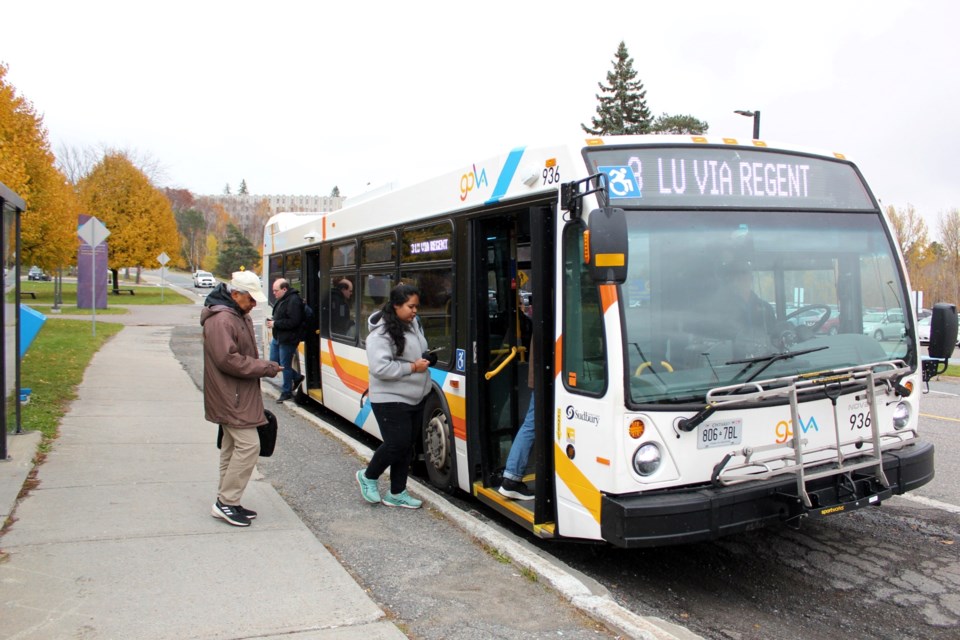
Ward 7 Coun. Natalie Labbée is set to champion a business case requesting free GOVA Transit use for seniors on Tuesdays, either weekly or the first of every month.
One hurdle laid in front of the proposal was raised in council chambers last month, when Ward 6 Coun. René Lapierre suggested that targetting just seniors might not be the right approach and Ward 8 Coun. Al Sizer said that not all seniors are unable to afford bus trips.
On this point, the age demographic Labbée targets for free bus rides, 65-plus, is the least-improverished age group in Canada. A Statistics Canada report using 2021 poverty rates cites a 4.7-per-cent poverty rate among Canadians aged 65 and older as the lowest for any age group, aided in part by their eligibility to receive the Guaranteed Income Supplement.
It was also pointed out that seniors and disability pensioners already receive discounted six-ride and monthly passes, paying $15 for a six-ride card (adult rate is $20) and $56 for a 31-day pass (adult rate is $100.50).
“There are a lot of people who are under these strict financial constraints, as seniors especially, who are experiencing a lot of mental health concerns, isolation,” Labbée said last month. “It’s growing to the point where people are in our hospitals and long-term care, they’re not aging in place as well because of isolation factors.”
Offering the program one Tuesday per month would cost the city $24,117, and offering the program every Tuesday year-round would cost $144,704.
Enhanced winter sidewalk maintenance
A business case calls for the city’s enhanced winter sidewalk maintenance pilot program to be made permanent.
The program has been in place for the past two winter seasons, and city council members voted in September to extend it to the 2025-26 winter season.
The pilot program has included the addition of three seasonal employees to supplement the existing 22 who undertake annual sidewalk winter maintenance efforts.
Similar to downtown sidewalk maintenance processes, these three additional employees maintain sidewalks within their respective sections on a rotational basis during business days and not just immediately following snow events.
“The pilot has proven to be a cost-effective solution that has enhanced overall service delivery and received positive feedback from council, staff and the public,” according to the staff-drafted business case. “Given the city's expected population growth, increasing infrastructure demands and the need for a resilient and responsive active transportation network, it is prudent to plan for sustainable long-term service improvements. It is therefore recommended that the continuous service pilot project be converted to a permanent maintenance feature.”
Last month, Sudbury.com published a letter by Greater Sudbury Safer Sidewalks member Naomi Grant which advocated for city council members to approve the business case.
“Doing so would support better mobility, health, safety and quality of life for all of us. It would benefit everyone, and it would especially benefit seniors, young families and those with mobility challenges,” she wrote. “It is the right decision for our city and for the wellbeing of residents.”
The business case calls for the purchase of three additional sidewalk plow units, bringing the 2026 tax levy impact to just greater than $1 million (0.27 per cent on the levy), and subsequent annual impacts beginning with $342,215 in 2027.
Additional context going into budget talks
Budget talks begin at 9:30 a.m. Tuesday.
The meetings can be viewed in-person at the Lionel E. Lalonde Centre in Azilda or livestreamed by clicking here.
Subsequent days’ meetings will be scheduled as needed, with meetings tentatively set to take place daily beginning at 9:30 a.m. through Thursday.
City council meetings have also been scheduled to take place at 1 p.m. daily which would allow city council members to ratify the budget decisions made during in-committee budget deliberations.
By the end of this week’s deliberations, they are expected to approve a final 2026 tax levy increase. The 2027 levy increase will also be approved, but remain tentative and up for review by the city council elected in the Oct. 26, 2026, civic election.
City council will approve its 2026 property tax policy in April 2026, which breaks down how the tax levy hike will affect each property classification, including residential.
The Municipal Property Assessment Corporation recently mailed out 2026 property assessment notices, which continue to rely on 2016 assessments as its baseline, plus whatever changes have been made to properties since that time.
The city’s overall assessment growth (new builds, expansions) was estimated at one per cent in the 2026 proposed budget, but is anticipated to only hit 0.8 per cent.
This reduction in assessment growth ($750,000 in municipal tax revenue) has been offset by an increase in provincial funding through the Ontario Municipal Partnership Fund. The city is receiving $27,559,800 in 2026, which is a $3.2-million jump from the $24,319,500 provided in 2025.
Although this article skims the surface to flag potential budget highlights, there are at least 36 business cases up for debate, all of which proposing service-level-changes.
Sudbury.com will attend all upcoming budget deliberations and will publish in-depth reports as the week progresses.
Tyler Clarke covers city hall and political affairs for Sudbury.com.