
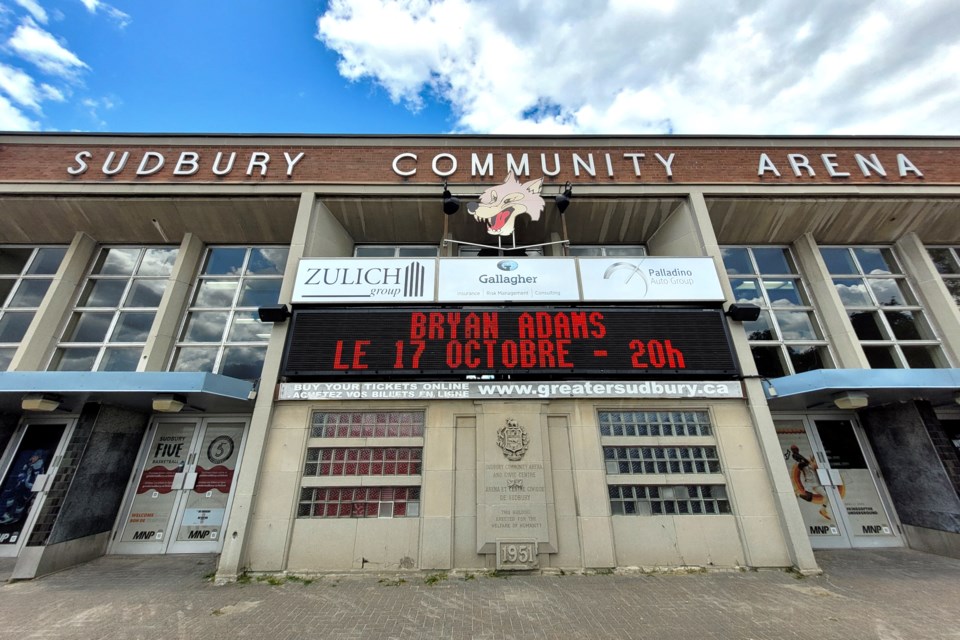
For 75 years, Sudbury Community Arena has stood at the centre of the city’s emotional and physical geography.
Long before it became simply “The Old Barn,” it was a promise to its residents — made of concrete, steel, and sweat — that the Nickel City would have a place of its own. A place big enough for ambition, loud enough for celebration and sturdy enough to endure triumph, disappointment, noise and time.
From the day the first skater crossed its ice to the echoes still ringing in its rafters after the most recent Wolves game, the arena was never just a building. It was a living space, shaped as much by the people who built it as by those who enjoyed it — and by the memories that have clung to it ever since.
For many residents, Sudbury Arena defies neat categorization. Ask residents what it meant to them, and the answer often comes quickly: everything.
“Roller skating, concerts, Oktoberfest, watching the Wolves play and practice, Canada Day celebrations,” recalled Anna Sitarz, neatly summing up the way the building folded itself into everyday life — it was all there, sometimes overlapping, sometimes colliding. Sudbury Arena did not specialize. And, that quality has made it indispensable.
For Claire Kat, it was both family and future. “I spent lots of time there. My brother played for the Sudbury Wolves and I figured skated. I attended many concerts and other activities,” she wrote, adding that revisiting its history stirred memories she hadn’t thought of in years.
Those memories weren’t always comfortable, but no matter, they were unforgettable.
Doug Williams remembered standing in the arena as a Cub Scout during a visit by Governor General Georges Vanier. “It was stifling in there and the Cubs were dropping like flies,” he recalled. When the boy in front of him fainted, Williams “grabbed him and with the help of other Cubs around me we laid him down.”
Built by Hands That Lived Here
Before the cheers, before the music, before the ice ever froze, Sudbury Arena existed first as a job site. And, for many local families, its story began not in the stands, but on scaffolding. From its foundations upward, the arena carried the fingerprints of Sudbury.
The building’s design reflected a distinctly local vision. As Fred Lane reminded readers, it was the work of architect J.B. Sutton, a Northern Ontario modernist whose buildings helped shape Sudbury and Copper Cliff. Sutton designed a structure that was practical, bold, and communal — never ornamental, always purposeful. His other local work included the Sudbury YMCA, the Salvation Army buildings on Larch and Lorne streets, and the Copper Cliff Public Library.
Robert Flintoff remembers being told, often and fondly, that the arena was built for him. His father, Tom “Red” Flintoff, was a bricklayer on the project. “I was born in 1949, the same year the arena was being built,” he wrote. “He always told me he helped build the arena for me.”
Chris Derro’s family wired the building. “My dad and his brothers from Derro Electric wired up that building,” he wrote. “A monumental task at the time.” He remembers the pride attached to that work, the reputation for precision, the knowledge that the lights coming on meant someone in his family had done the job right.
Others remembered the work that happened before construction even began. Alan Arkilander remembered the quieter labour behind the scenes: fundraising. His father was one of the businessmen who helped raise the money to make Sudbury Arena possible.
Learning to Skate, Learning to Belong
For countless Sudbury children, the arena was where cold bodies learned balance, courage, and confidence. Vicki Thurlow remembered skating lessons in 1957 under Sandra Duncan, while Joyce Salo taught private students nearby. “The up-and-coming star at the time was Mary Ann Humphries,” she recalled. “Her mom worked at Fairmount Shoes and was so proud.”
At season’s end, the students put on a show. Costumes were sewn at home. “My mom made my beautiful costume — baby blue satin with silver stars,” Vicki wrote. The children froze in the cold rink, teeth chattering. “We came off the ice as blue as our dresses,” she remembered, but the warmth of the memory never faded.
Hockey: Close, Loud, and Personal

Hockey at Sudbury Arena was intimate by design. The stands were steep, the ice close.
Jim Curry put it plainly: “Still a great arena to watch a hockey game. The stairs are a bit steep but the stands are close to the ice as a result.”
Frank Scott, son of the structure’s original engineer, shared how the Sudbury Arena quietly influenced hockey tradition far beyond the city. In 1956, when Howie Meeker was head coach of the Toronto Maple Leafs, part of the team’s training camp was held in Sudbury.
During that time, a Maple Leaf was painted at centre ice, likely by Bruno Cavallo. Meeker was so taken with the idea that he had the Maple Leaf painted at centre ice at Maple Leaf Gardens in Toronto, something that had never been done before.
For teenagers like Ken Scott, the arena became an after-hours sanctuary. One lightbulb hung over the west end as games stretched late into the night. “Frank allowed some of us teenage boys to stay and play hockey till the wee hours,” Scott said.
Andy Béland remembers scoring his first playoff goal there in 1967 with the Nickel City Rollers. “We had the arena to ourselves every Monday night,” he wrote. “Good times!!”
Sudbury Arena often hosted legends before they were legends, though not every memory was fond. Gerry Cheevers passed through in the early 1960s and Larry Richardson remembers waiting for autographs after a game — only to be ignored. “I remember it like it happened yesterday,” he wrote. “After that, I was never a fan of him or the Boston Bruins.”
When the Montreal Canadiens came to town in 1955, they arrived by train and fans gathered to watch them step off and walk straight across the street into the arena. Frank Scott served as their stick boy. “After the game,” he recalled, “they gave me $2.”
Even global politics reached the ice. In 1975, the Wolves faced the Moscow Selects, briefly turning Sudbury Arena into a Cold War crossroads. David Lalonde remembered the Russian players walking to the dressing room. “They looked like giants!” The Wolves lost 11-4, but the Sudbury roster included 11 future NHL players.
For longtime fans, the memories extended beyond the ice.
Ron Barr, a season ticket holder in the 1970s, remembered draft beers at the Ledo between periods and Dino the Popcorn Guy outside.
Margaret-Ann and Gord Cormier recall 30 years of Wolves season tickets and watching future NHL stars pass through, including “Mike, Nick, and Marcus Foligno, and the four Staal brothers.” They also remember the voices that defined the experience — Berk Keaney Sr. and Joe Bowen — calling them “two of the best announcers in hockey,” echoing through decades.
The Wolf in the Rafters

Few traditions have captured Sudbury Arena’s personality like the wolf. It is more than a gimmick — it tells fans they are part of something distinct. Something unmistakably Sudbury.
In the early 1950s, arena manager George Panter, always looking to elevate the fan experience, transformed a stuffed wolf into living theatre. Suspended above the ice and lowered through a trap door after every Wolves goal, accompanied by a recorded howl, the wolf quickly became iconic.
Even visiting NHL stars took notice. During an exhibition game against the Montreal Canadiens, Doug Harvey reportedly watched the wolf descend with fascination. After Sudbury finally scored while trailing 5–0, Harvey deliberately put the puck into his own net just to see it again.
“It was worth it to see that wolf again,” he told coach Toe Blake.
Noise, Music, and Youth

If hockey was the arena’s pulse, concerts were its rhythm.
In 1967, Sudbury Arena became a vessel for collective voice when the Confederation Choir gathered on the ice for a national celebration. Brenda Roseborough recalled the moment through a photograph: rows of young singers beneath Sudbury Arena’s wide ceiling, small figures in a vast space that suddenly felt intimate.
For Cheryl Duhaime, the memory remains vivid decades later. “I remember that day so well. It was very exciting,” she wrote. She sat in the orchestra while her brother sang in the choir, the result of two years of preparation. On that day, the arena — so often defined by noise and motion — held something different: discipline, harmony, and the quiet pride of young voices raised together.
Over the years, Stompin’ Tom Connors also took the stage, usually to mixed teenage enthusiasm. Melanie MacRae recalled being dragged there by her parents and sneaking in a transistor radio to listen to CHNO. “So glad now,” she wrote, “as it’s part of good memories.”
Rock concerts were another matter entirely.
KISS on July 19, 1977, became instant mythology. The arena was packed beyond capacity. Tom Marciniak recalled it as “the biggest act to ever hit Sudbury at the time.” Too young to attend, he still remembered the city buzzing as older teens scrambled for tickets.
Kenny Hill remembered the rush when the doors opened. “There was such a surge to get in that I think some of the main doors were damaged,” he wrote. By the third encore, the house lights came on “as if the concert should have been over.”

Behind the scenes, security guard Ron Ranta found himself eating watermelon with Gene Simmons and witnessing chaos up close. He recalled a broken beer bottle attack “carried out by Peter Criss on Ace Frehley who had apparently over medicated himself for the performance.”
“During all the concerts I worked security in the ’70s, I never had to lay my hands on anyone,” Ranta added, “but the closest I came was at this concert.”
Another guard, Gerald Bronson, was stationed between the stage and the crowd, directly in front of the speakers. “Lost my hearing for three days,” he wrote.
The impact extended beyond the building. Matthew Frederick recalled being told by someone working in the CPR yard across the street that night that the music was clearly audible — and that “the ground vibrated at times.” He also noted that the concert became infamous for a late pyrotechnic blast that damaged the ceiling above the stage. “Arena officials stuck the band with the bill for the repairs, which they were not happy about.”
AC/DC’s Back in Black tour in 1980 pushed volume to its limits. “Cranked up the sound to max,” wrote Mike Robert. “You couldn’t even make out what song they were playing.” Gary McDonald added simply: “My ears rang for days.”

Metallica’s 1986 stop left an especially deep imprint. “A fever dream come true,” wrote Alain Gaudrault. “An amazing concert, after which we stood outside waiting for a glimpse of them on their way out. Luckily got them to sign a poster, subsequently framed.”
Another reader, Alan Gobbo, remembers being 15 years old “rocking at the (Marshall speaker) stacks … at least 20 feet high.”
And, if KISS, AC/DC and Metallica were about volume and spectacle, the Ozzy Osbourne concert in March 1983 revealed something else the Sudbury Arena could hold: fear, misunderstanding, and the cultural tension of its time.
For some, simply reaching their seats felt like crossing a line. Ken Shank remembered “walking thru the freaks with the ‘Satan’ signs,” a gauntlet of protest before a single note was played. Tammy Maki recalled sitting behind “a bunch of upset community members with signs,” still baffled decades later. “Never did understand why they got into such a lather about him.”
Others never made it inside at all. Lana Watier had a ticket — until it was taken away. “My mom returned it to the box office and wouldn’t let me go because of that ridiculous ‘satanist’ BS,” she wrote. For her, Sudbury Arena became a place defined by absence, a memory shaped as much by what was denied as by what occurred. Inside, however, the show unfolded as so many arena events did: loudly, intensely, and without apology.
Wrestling, Giants, and Childhood Awe

Wrestling nights at the Arena brought spectacle on a truly gigantic scale. (literally)
When Jean Ferré — later known as André the Giant — appeared in 1972, his size alone became legend. Tony Karol recalled that he had to duck and turn sideways to fit through the arena’s doors. Children craned upward just to touch him. Tim Fitzpatrick “had to jump to pat The Giant on the shoulder” while Jamie Jones, only nine at the time, shook his hand in a hallway and never forgot that it was “the size of a tennis racket.”
Albert Edmund recalled something else entirely: kindness. Ferré, beer in hand, took time to greet everyone. “He shook hands with all the kids and adults present and was very, very kind,” Edmund wrote, noting with amazement that he drank multiple beers while doing so.
In the ring — and beyond it — the action was just as memorable. Chris Derro remembers seeing him smash “Don Leo Johnathan's head against the rink boards when the action spilled out of the ring and onto the floor of the arena.”
Daniel Grimard tried to intervene, attempting to “stop Don Leo Johnathon from hitting Jean Ferre with the wooded guard rail with a big hemp rope through it,” adding that he still has the rope burns.
Quiet Stones Sliding
Not every defining arena moment came with noise or spectacle. In its quieter hours, the building revealed a different strength — its ability to hold stillness.
In 1983, Sudbury Arena transformed into a cathedral of concentration as it hosted the Labatt Brier. The sounds were subdued: no wolf howl, no amplifiers — just breath held, tension, and the low thunder of curling stones sliding across ice.
Bill Bruins remembers being there almost daily. “I met a lot of the players in the patch,” he wrote. The final — Werenich versus Lukowich — was “a classic,” but what lingered was the atmosphere: respectful, intense, almost reverent.”
For Michael Laporte, the Brier was personal. “My mother Hilda Laporte was an avid curler,” he wrote simply. And, for that short stretch of time “she lived there.”
This was not the first time curling had claimed the building. In 1953, Sudbury hosted the MacDonald Brier, proving even then that the building could command national attention without spectacle. Film footage from that year shows a confident young city welcoming the country.
Thanks to the power of YouTube, you can actually watch a 30-minute video of that 1953 Brier. Check it out.
The arena as a place to grow up
For many, Sudbury Arena was where independence first took shape.
One reader (lincar45) remembered summers spent dancing on the arena floor and the thrill of winning an Elvis Presley LP just before they turned 16. “Through the thick and thin of this life I have hung on to that long-playing record,” they wrote.
Others simply lived there. “Spent a lot of good times at the arena,” wrote Stan Zahorouski. “I was a regular rink rat!”
For some, living downtown meant Sudbury Arena became an extension of home. Sandi Cooper-Leblanc spent so much time there it blurred into daily life. “I remember the skating change rooms and had Joyce Salo as my figure skating coach.”
Behind the scenes, the arena was also a workplace. For those young workers, the arena was both a responsibility and a reward. Don Wright sold peanuts, popcorn and Cracker Jacks in the mid-1950s, earning a few dollars a night. “I got to see all the games,” he wrote, “and enjoyed that wolf howl when Sudbury scored. Sometimes (I) earned $2 over the course of the game … not bad when we were 14–15 years old,” he wrote.
For newcomers, Sudbury Arena was an initiation. Bob Brawley remembers arriving from Scotland in 1957 and standing room only during his first week in Sudbury, watching hockey in a place that immediately felt important.
Well dear readers, if this story proves anything, it’s that Sudbury Arena was never short on ice time for memory-making. Thank you for dusting off the old programs, dropping the puck on a forgotten story, and letting one more memory echo like a goal horn you can still hear in your bones. From wolves howling in the rafters to stones sliding in silence, from amps turned to eleven to skates wobbling through first lessons, you’ve shown us that these recollections don’t belong on the bench. They’re meant to be passed, shared, and occasionally slammed into the boards.
See you again in two weeks for another skate down Memory Lane.
Jason Marcon is a writer and history enthusiast in Greater Sudbury. He runs the Coniston Historical Group, the Sudbury Then and Now Facebook page and is the host of Sudbury Memories on the Spaces platform.