
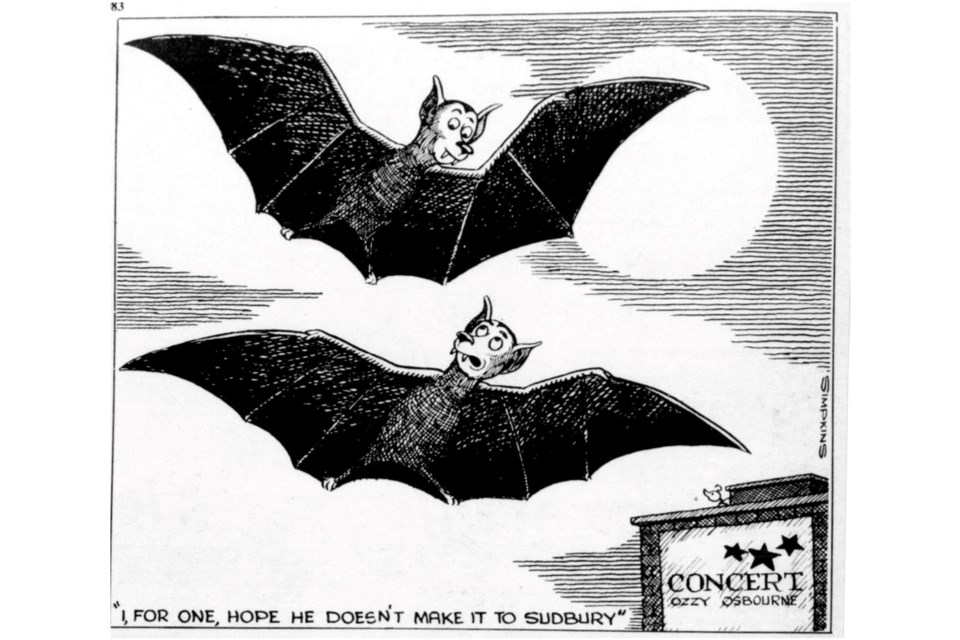
Ozzy Osbourne — the self-proclaimed "madman of rock’n’roll" — has always been a lightning rod for controversy, but rarely has he stirred a civic debate as intense as the one that occurred in Sudbury back in 1983.
With the passing of the legendary rocker on July 22, history writer Jason Marcon dug into the city’s past to unearth this historical tidbit: the time Ozzy Osbourne was set to play a show in Sudbury in 1983 and ran smackdab into angry parents, religious leaders and politicians, whipped into a frenzy of anti-heavy metal fury by the “Satanic Panic” of the 1980s.
Ozzy comes to town

In what was described as one of the most heated council sessions in recent memory up to that time, approximately 500 residents packed Civic Square and its surrounding areas on March 29, 1983, to debate whether Ozzy Osbourne should be allowed to perform at Sudbury Arena. Loudspeakers carried the proceedings to a crowd gathered outside the chambers, while those inside witnessed emotional testimony and heated exchanges between council members and citizens.
Approximately 90 per cent of those in attendance opposed the rock star’s appearance, citing his controversial lyrics, imagery, and influence on youth. As one speaker described it, the event bordered on the bizarre.
Much of the opposition centered around Osbourne’s stage persona, his association with satanic symbols, and what many considered blasphemous lyrics.
Reverend Jean-Paul Regimbal, a Trinitarian priest from Quebec who had spoken in over 53 countries on matters of satanism, claimed Osbourne’s music was “a manifestation for Lucifer” and likened it to the “demonic cult of the late Luciferian Cultist Aleister Crowley,” best known as “The Beast” and “Mr. 666.”
Regimbal further argued that Osbourne’s lyrics, including those in songs like "Believer" from the “Diary of a Madman” album, masked a satanic message encouraging listeners to “serve Satan, youth and onlookers.” He insisted, “You can’t kill rock and roll,” a lyric from Osbourne’s music, was evidence of satanic ideology hidden in pop culture.
In his presentation, Regimbal also stated that the recording and promotion companies handling major rock groups were “owned and operated by the Luciferin sect called the Illuminati.”
Reverend Jeremy Mahood of the All Nations Church also addressed council on the importance of barring Osbourne, even comparing him to the Satan’s Choice Motorcycle Club, stating that “an end should be put to this atrocity,” which drew a response from a crowd member who told him to “go spout that trash somewhere else.”
Prior to the meeting, Philip Popovich of Full Moon Productions distributed a press release showing that Jean-Paul Regimbal had previously written that he deemed ABBA, the Beatles, the Bee-Gees, the Village People, Elton John and John Denver to be “satanic influences.”
Audience members pounded on glass and booed, despite warnings from Mayor Peter Wong about the risk of shattering the council chamber windows. Meanwhile, council members Sterling Campbell, Ted Nicholson, Gary Peck, Ron Symington and Wong voted in favor of allowing the concert to go ahead. Councillors Frances Caldarelli, Diane Marleau and Ricardo de la Riva were among the eight who opposed.
‘I just ignore these people’

In the end, council voted to allow the concert to continue, citing a binding contractual agreement with promoter Donald K. Donald. City Solicitor Fred Dean warned that cancelling the event could lead to a costly lawsuit from Osbourne for loss of revenue and damages to his reputation.
In an exclusive interview with Northern Life the day of the concert, Osbourne addressed the controversy directly.
“I think they’re all just a bunch of religious fanatics,” he said. “I just ignore those people. I don’t let it get to me and besides, I don’t have the time to pay attention to them.”
Despite his provocative image, Osbourne said there’s another side to the persona that dances wildly across the stage.
“He’s quiet, sometimes shy, and even a bit nervous in front of strangers,” the article noted, adding that close friends know him simply as “John”.
During the interview, Osbourne spoke warmly about his North American tour and particularly the fans in Sudbury.
“The kids are great up here. They really love rock’n’roll. I just wish my voice was a bit better. I’ve been ill for awhile,” he said. “We’ve (his band) all had this flu bug which I’m just recovering from. I felt good tonight for the first time in weeks.”
Osbourne was touring without his manager-wife, Sharon, who was back home in England preparing to give birth to their second child (daughter Aimee). The 33-year-old singer said the only downside to touring was being away from his family.
“I miss being at home very much,” he said. “My family is very important to me. But this is what you’ve got to expect when on tour.”
Born in 1948 in Birmingham, England, Osbourne grew up listening to The Beatles and the Rolling Stones. In 1968, he co-founded Black Sabbath before embarking on a solo career.
In 1983, his album “Speak of the Devil” was coming under fire from nearly every major religious organization in North America, including Sudbury’s Christian community. The album cover, depicting Osbourne with a mouthful of blood and satanic imagery, only fueled the controversy.
Nonetheless, the album was a commercial success.
“The album is doing very well,” Osbourne told Northern Life. “It’s gone gold in Canada and has gone gold in the States, and it looks as though it’s going to go platinum in both countries.”
Many of Osbourne’s critics pointed to recurring themes of insanity and the occult in his lyrics, including references to the Christian devil, upside-down crosses, and cross burnings.
Osbourne, however, attributed these to metaphorical representations of his inner conflict.
“Perhaps it is this dichotomy that moves him to write about going insane in songs such as ‘Crazy Train’,” noted Northern Life. Unlike most performers, Osbourne agreed at the time stating that sometimes he cannot separate the good and evil voices in his head. One telling him to be Ozzy; the other telling him to just be John.
At the heart of the debate was a question that has long haunted rock music: where is the line between artistic expression and moral danger? While civic leaders in Sudbury ultimately voted in favour of allowing Osbourne’s concert, the debate revealed deep divides within the community.
From claims of satanic influence to passionate defenses of free expression, the Ozzy Osbourne debate became a landmark cultural moment in the city’s history.
Well dear readers, the crown Prince of Darkness has passed beyond the “Wall of Sleep.” Were you at the show? Do you remember the debate and the Satanic Panic? Share your thoughts in the comments section below this article.
Whether viewed as a misunderstood artist or a dangerous icon, one thing is clear — Ozzy Osbourne knew how to get people talking.
“Now from darkness, there springs light
Wall of sleep is cool and bright
Wall of sleep is lying broken
Sun shines in, you have awoken.”
(“Behind the Wall of Sleep” - Black Sabbath)
RIP OZZY
Jason Marcon is a writer and history enthusiast in Greater Sudbury. He runs the Coniston Historical Group and the Sudbury Then and Now Facebook page. Memory Lane is made possible by our Community Leaders Program.