

Revitalizing downtown Sudbury was a clear priority of city council in 2023, with the city’s elected officials inching closer toward their arena/events centre and library/art gallery projects.
These major projects join emergency services infrastructure, tackling the city’s infrastructure spending gap and city council members behaving badly in filling out the list of key trends in city council news this past year.
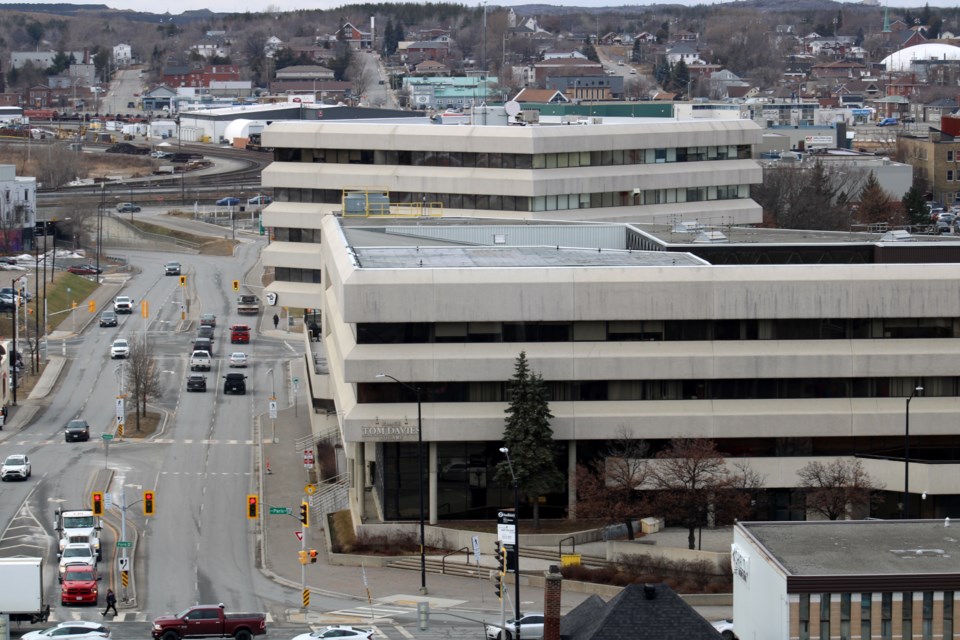
In late November, city council greenlit a $65-million library/art gallery project to take shape at Tom Davies Square, which is expected to open by the end of 2026.
Meanwhile, city council members voted to purchase several downtown properties to the immediate east of the Sudbury Community Arena to accommodate an arena/events centre project, at a total cost of $12.5 million to date.
Businesses on affected properties have already started to close, including Golden Grain Bakery and the cafe portion of Brûlerie Old Rock Roastery, while Wacky Wings goes through expropriation and Alexandria’s Restaurant’s owner has been planning its relocation.
The city plans on having all the buildings on this block (and the triangular block to the south, which they also purchased and includes the historic Ledo Hotel building) demolished to make way for the arena/events centre project.
City council is expected to decide by March 2024 whether to proceed with a renovation of the existing arena or the construction of a new building.
The properties the city purchased will either accommodate the new arena building or ancillary services, such as a hotel, convention centre or other ventures that might complement the development.
“The goal is to stimulate and create that economic hub,” Mayor Paul Lefebvre said in October, adding that by purchasing these properties, the city holds the cards.
Both the arena/events centre and library/art gallery project have reached similar stages in the past.
In June 2022, city council approved a $98.5-million Junction East Cultural Hub project, which would have included a new building containing a library and art gallery downtown on what is currently the parking lot of the Sudbury Theater Centre.
Preparation work began at the property in September 2022, when an Enbridge gas line was relocated to make way for the library/art gallery.
In February 2023, a newly elected city council voted to shave $33.5 million from the library/art gallery project, which effectively killed the Junction East Cultural Hub and put the city on course to shift the project to its current proposed location at Tom Davies Square.
Also in 2022, the city was on a years-long course to approve an arena/events centre project called the Kingsway Entertainment District on The Kingsway, which city council members shot down in July 2022 when its cost more than doubled to $215 million.
This put the arena/events centre project on a new path toward its downtown incarnation.
Despite both projects having been at similar stages of approval in the past, Lefebvre told Sudbury.com in November that he believes the library/art gallery is “in stone.”
Only three city council members voted against the $65-million library/art gallery project, including Ward 7 Coun. Natalie Labbée, Ward 11 Coun. Bill Leduc and Ward 2 Coun. Michael Vagnini (Ward 3 Coun. Gerry Montpellier was not present for the vote).
The downtown arena/events centre project also appears likely to proceed, having received near-unanimous support from city council (only Vagnini voted against it, and Montpellier was not present for the vote).
Emergency services infrastructure renewal
The city’s proposed reconfiguration of emergency services infrastructure was always going to be a controversial subject.
The issue caused a stir in 2017 before being abandoned for a few years, and an early leaked page from the latest effort caused controversy last year when it was revealed to propose consolidating several halls.
Wide-sweeping changes to the city’s network of emergency services infrastructure was later proposed, including several fire hall consolidations, prompting Ward 7 Coun. Natalie Labbée to request a series of public consultation meetings, which a vote of city council members supported.
Meetings were held throughout Greater Sudbury in 2023, and were notably well attended in Skead and Beaver Lake, whose emergency services stations were both slated to close.
In Beaver Lake, area residents took over the public consultation meeting by bringing their own sound system to pepper city staff with questions.
Community members used the microphone to take turns telling city staff why they believe their proposal to consolidate the Beaver Lake fire station into the Whitefish station several kilometers east was a bad idea. Although the microphone was occasionally put to city staff for their response, it was primarily a one-way conversation.
In the end, city council members voted in favour of various changes to emergency services infrastructure, amending the city’s plans in order to save both the Skead and Beaver Lake stations (as well as repair the Skead station).
That is, pending they achieve “adequate average staffing levels for volunteers in stations at the time.”
Both stations have long failed to meet the city’s minimum target requirement of 15 volunteer members, with Beaver Lake sitting at four members at the time, while Skead sat at one.
Within the city’s 2024-27 capital budget, city council approved the following as part of phase one (2024-27) of the emergency services infrastructure renewal plan:
- New station build in Garson: $11.8 million, plus $1-million land purchase (consolidating Falconbridge, and possibly Skead if their volunteer numbers don’t improve enough)
- New station build in Minnow Lake: $9.2 million, plus $2.1-million land purchase (to be approximately two kilometres north of the current building, which would close)
- Renovating the Val Therese station: $17.4 million (Val Caron an Hanmer stations to consolidate into the Val Therese station, with the Val Caron and Hanmer buildings to close)
- Renovating the Van Horne station: $16.2 million (to be used by both fire and paramedic services)
- Renovating the Long Lake station: $10.8 million (to be used by both fire and paramedics)
The following was approved as part of the second phase (2028 and beyond)
- Renovate the Dowling station: $7 million (will absorb the Vermillion Lake station)
- New station build in Lively: $15.1 million, plus $1-million land purchase (consolidate existing Waters, Lively and Copper Cliff stations in the new building, and close old buildings)
- New station build in Wahnapitae: $13.4 million, plus $1-million land purchase (to consolidate Wahnapitae and Coniston stations, whose old buildings would close)
- Renovating the Capreol station: $8.9 million (to be used by both fire and paramedic services, with the existing Capreol paramedic station to close)
- Renovating the Whitefish station: $7.5 million
- Renovating the Azilda station: $6 million
- Renovating the Chelmsford station: $16.4 million
- Renovating the Levack station: $7.4 million
- Renovating the New Sudbury station: $10.4 million
- (Beaver Lake and Skead renovations are contingent on staffing)
Including land purchases the two phases are projected to cost a total of $164.6 million.
The changes are intended to modernize the city’s collection of aging emergency services infrastructure, with consolidations intended to help pare down the overall expense.
The city’s 24 fire/paramedic stations range in age from 17 years (Azilda) to 70 (Lively). The average age of the city’s career stations is 43, and the average age of volunteer stations is 50. The city’s estimated life cycle for stations is approximately 50 years.
The cost of maintaining the city’s 24 stations was expected to hit $43 million over the next decade.
By consolidating some stations, the hope is that more stations will draw from a larger catchment area and achieve the target minimum of at least 15 members.
This year, 42 volunteer firefighter recruits were offered positions, including five in Beaver Lake and 11 in Skead.
Meanwhile, volunteer firefighter advocates are pushing for any member of city council to table a motion to bolster funding for volunteer firefighter recruitment efforts and training opportunities to ensure more stations meet the 15-member goal, and that the Skead and Beaver Lake stations can remain open.
Tackling the city’s infrastructure spending gap
The City of Greater Sudbury’s infrastructure spending gap is now estimated to be $130 million.
This annual spending gap, city general manager of corporate services Kevin Fowke explained to city council in December, is the “capital funding gap between the average annual requirement and the five-year historical average that we’ve invested.”
In short it’s the amount the city is currently underspending on its assets.
As such, city assets are currently degrading.
The city’s five-year historic annual investment on roads has been $35 million, when the amount needed to maintain them in their overall current condition is $80 million. This leaves an average annual gap of $45 million in roads spending, which sets them on track to fall from an overall grade of “fair” to “poor” by approximately 2030.
Baked into the city’s 2024-27 capital budget, which city council members approved in December, are provisions to take on an additional $124.4 million in debt to help tackle the infrastructure gap.
During budget deliberations, city council members also voted to tack on a 1.5-per-cent special tax levy to help fill the infrastructure gap.
Between these and other budgetary decisions, the city’s 2024-27 capital budget totals $877.2 million, which averages out to $219.3-million annually and exceeds the 2019-23 annual average of approximately $160 million by 37 per cent.
Alongside paring down the city’s infrastructure spending gap, the city has also been contending with inflationary pressures.
City staff cut $10.5 million from the status-quo base budget before city council members even got to it, through such things as increasing bus fare by seven per cent (city council members ended up voting to increase it by 14 per cent to further lessen the tax burden), baking less wiggle room into the city’s finances and allowing longer gaps before hiring staff to replace those who leave.
This builds upon city staff’s 2023 budgetary decisions (following city council direction), which resulted in them slashing $17.8 million from that year’s base budget using similar tactics.
City council members approved their 2024/25 operating and 2024-27 capital budgets in December, which included a 4.8 per cent water/wastewater rate increase in both 2024 and 2025, a 5.9 per cent tax levy jump in 2024, and a 7.3 per cent tax levy increase in 2025 (which city finance and administration chair and Ward 9 Coun. Deb McIntosh said is likely to drop when the budget is reviewed in late 2024).
Council behaving badly
In a repeat performance (see Sudbury.com’s 2021 year in review and 2022 year in review), some members of city council raised controversy in 2023.
Ward 2 Coun. Michael Vagnini has had his microphone muted by meeting chairs numerous times throughout the year in response to his talking out of turn.
“Go back to your federal government,” Vagnini told Mayor Paul Lefebvre on Dec. 5, after repeatedly talking over others during the meeting and being called to order by the mayor.
“You’re blind to what’s going on out there,” Vagnini told his colleagues after city council members voted 8-4 to kick him out of a July 11 meeting.
Vagnini’s expulsion from the meeting, which he attended virtually, came immediately after he talked over Mayor Paul Lefebvre, who’d been attempting to rein in the councillor’s comments.
“T-t-t-t-t ... let me finish,” Vagnini said over Lefebvre.
“That crosses a line, and we’re done,” Lefebvre responded, at which point the mayor proceeded to read from the city’s procedure bylaw, which he had at the ready and allowed the vote to expel Vagnini to take place.
Vagnini was also one of three city council members who attended a controversial meeting at the Northbury Hotel on Sept. 7, where Road Surface Recycling vice president technology and research Frank Crupi lobbed unproven claims of bribery and incompetence at city staff.
Crupi was speaking out in opposition to the city’s decision to pull his company from an asphalt recycling project on The Kingsway.
Ward 11 Coun. Bill Leduc and Ward 3 Coun. Gerry Montpellier also attended the meeting.
City CAO Ed Archer censured the three city council members for attending the meeting, and directed Leduc to no longer speak with city staff directly until further notice, and to filter questions through him.
City integrity commissioner David Boghosian later recommended a 10-day suspension in pay for Montpellier and a 30-day suspension for Leduc.
Boghosian did not recommend sanctions against Vagnini, as he was not found in breach of the city’s Code of Conduct.
In conversation with Sudbury.com, Vagnini claimed he “wasn’t even in the room when all the stuff was going on” — the “stuff,” being Crupi’s claims against city staff.
Vagnini said he left after approximately 20 minutes for a media interview and then went home, but Sudbury.com noted his attendance during several points throughout much of the three-hour meeting, including as late as two hours and 15 minutes.
In a since-deleted Facebook post, Montpellier said Boghosian’s report included accusations against him using “fancy words” like “discrimination,” “collusion,” “sexist” and “misogynistic,” adding, “I actually do not know what some of them mean.”
During the Sept. 7 meeting, Leduc clarified the relationship status of two city staff members to the audience, which Boghosian argued added fuel to the meeting’s anti-city rhetoric.
Montpellier also contributed to the anti-city rhetoric, according to Boghosian’s report, when he pointed out that the same staff members responsible for cancelling the asphalt recycling contract had also “built Maley on private property,” in reference to an ongoing lawsuit claiming the city built Maley Drive on land it didn’t expropriate prior to construction.
The city’s elected officials were unanimous in supporting the suspension against Leduc, and only Vagnini voted against sanctioning Montpellier.
Leduc has also been accused of using a 2022 Grandparent’s Day event to boost his re-election campaign without claiming it as an election expense. The Election Compliance Audit Committee determined there was grounds for a review, and has enlisted KPMG to audit Leduc’s finances, the results of which have yet to be released.
In the wake of the Election Compliance Audit Committee’s meetings, Leduc ran afoul of the city’s integrity commissioner for breaking the city’s Code of Conduct.
In a radio interview, Leduc claimed the complainants behind the audit “tampered evidence” against him, which there was no evidence of.
Although Boghosian concluded that Leduc’s radio interview comments were “objectionable and impertinent,” and breached the Code of Conduct, he also said they did “not quite rise to a level warranting sanction by council.”
Looking toward 2024...
The city’s elected officials have already set the stage for a handful of potential 2024 year-end highlights.
The emergency services infrastructure renewal efforts are slated to continue, and further decisions will be made on the downtown library/art gallery and arena/events centre projects.
A 2025 budget update is anticipated to take place in late 2024, at which time finance and administration committee chair and Ward 9 Coun. Deb McIntosh said she anticipates they pare down that year’s tentative 7.3-per-cent tax levy increase.
More reports will be provided in the city’s infrastructure spending gap in advance of the July 1, 2025 deadline imposed by the province to select service levels which more accurately correspond with how much is being spent on infrastructure.
The city’s Housing Supply Strategy is expected to be approved by mid-year, and a final Aquatic Services and Facilities Review will be presented to city council in September 2024.
The Housing Supply Strategy will map out a plan to increase housing supply to accommodate a Greater Sudbury population of 200,000 by 2050, while the Aquatic Services and Facilities review will help decide the future of the city’s aging aquatic facility infrastructure.
Tyler Clarke covers city hall and political affairs for Sudbury.com.