

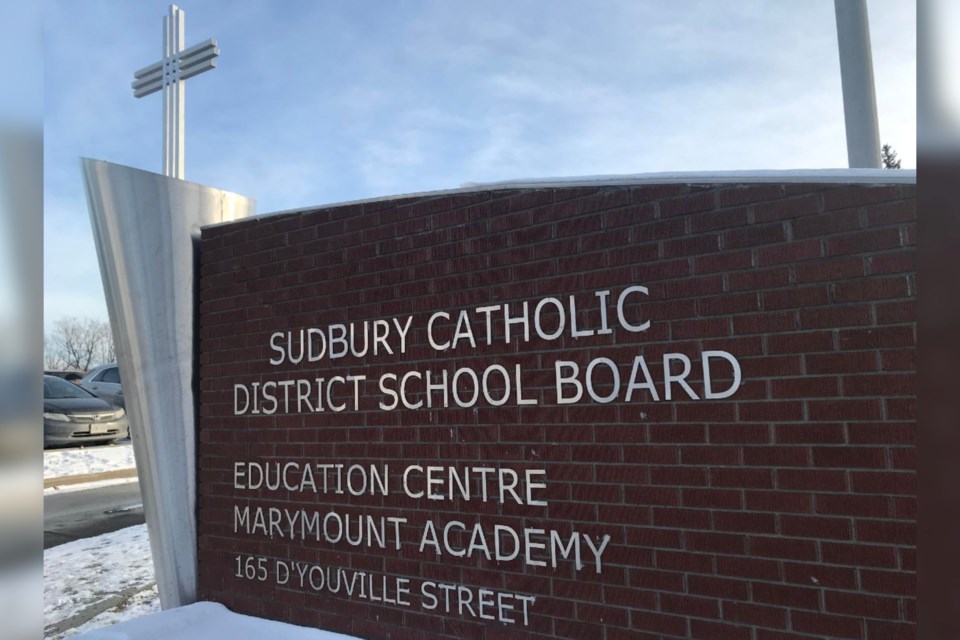
IT support — including the cost of fending off cyber attacks — special education, inflationary costs, statutory benefits and the extension of technology education are some of the areas in which the Sudbury Catholic District School says it’s underfunded.
The board says the situation is making it such that even though there’s an uptick in enrolment, it’s expecting an already slim surplus for 2025-2026 to become even slimmer.
Trustees with the board heard a report from executive superintendent of business and finance Cheryl-Ann Corallo at the Dec. 16 meeting which presented the revised budget estimates for the current school year.
Back in June, the board was expecting a surplus of $16,414 for 2025-2026, but that’s now just $3,677 on a $128-million budget.
Corallo said the board’s enrolment as of Oct. 31 of this year was 174 students higher than what was projected in the spring. While that brought in additional revenue, it also required the board to do some hiring, and “of course, our … funding didn't increase enough to accommodate all these positions. “
An additional 15 teachers, two early childhood educators, an Indigenous support worker, an attendance counsellor and an administrative assistant were among those hired as a result of the enrolment growth.
“It was very challenging to get a balanced budget for this year,” said Corallo. “We had to go back several times and make several cuts in areas. But I am happy to say that the majority of the cuts that were made were in the corporate side, not in the instructional side.”
The Sudbury Catholic board also approved its audited financial statements for 2024-2025 at its November meeting, in which it posted a small surplus of $39,115, as opposed to the projected deficit in the budget of $938,529, which it was planning to cover with reserves.
While factors such as higher enrolment and unfilled positions played a part, Corallo said there was some strategy in projecting a deficit for the last school year to make a point about unfunded expenses.
“In all honesty, we had intentionally shown a deficit budget because there are some funding things that, provincially, we want to bring to the ministry's attention that are not funded,” she said.
“I think it was messaging to say, ‘We need to look at the funding’,” said board chair Micheal Bellmore, also president of the Ontario Catholic School Trustees’ Association.
“There's a Herculean cry right now about funding for school boards in this province, and we need to look at it.
“The change of minister (Paul Calandra, appointed education minister in 2025) has made us refocus and double down on our efforts.
“I mean, we've always been a responsible board. We've always maintained a fiscal surplus.
“So this was a structural deficit (expenses are more than grants), which, of course, is different than a non-structural deficit. So we just re-looked at things and decided to bring everything back in line and ensure that we were balanced.”
In terms of the current school year, a document in the package for the Dec. 16 meeting lists in detail the areas in which the board is underfunded.
In special education, there’s been a surge in student needs, particularly in the areas of complex behaviour, mental health and well-being following the pandemic, said the board document.
“We have also had to create more specialized programming to meet the needs of students with
complex needs who present with violent and/or aggression towards staff and students,” said the document.
“The students would otherwise not be able to attend school. These measures are essential not only for supporting students effectively but also for ensuring the safety and well-being of both
students and staff in increasingly complex learning environments. While these additions are critical, they have significantly increased costs.”
The board said it’s facing IT funding challenges related to the cost of devices; protecting the board from cyber attacks (such as seen recently with the Rainbow District School Board and Laurentian University) with an unfunded cost of $300,000 a year; and the introduction of the use of AI technology.
Supply costs had a funding gap of $1.5 million and statutory benefits such as employer CPP costs had a funding gap of $200,000.
“There's tons of pressures,” said Bellmore.
Also at the Dec. 16 meeting, the Sudbury Catholic board also approved the awarding of a $329,936 contract for two modular classrooms (i.e. portables) to be installed at St. Benedict Catholic Secondary School by ATCO Structures & Logistics Ltd.
The board has installed several modular classrooms in recent years, including at Holy Trinity, Bishop Alexander Carter and St. Benedict schools.
Bellmore explained that the province no longer allows the at-times-controversial former accommodation review process that involved boards looking at space needs, and often closing, amalgamating, expanding or building new schools.
There may be space pressures in some schools in one area of the city and empty classrooms in others, he said.
“But because they're in our board, it doesn't matter where they are,” Bellmore said. “That impacts us from the ability to ask for money to expand a school. So portables is something that the ministry is allowing for, and it's happening all over the province.”
Heidi Ulrichsen is Sudbury.com’s assistant editor. She also covers education and the arts scene.