

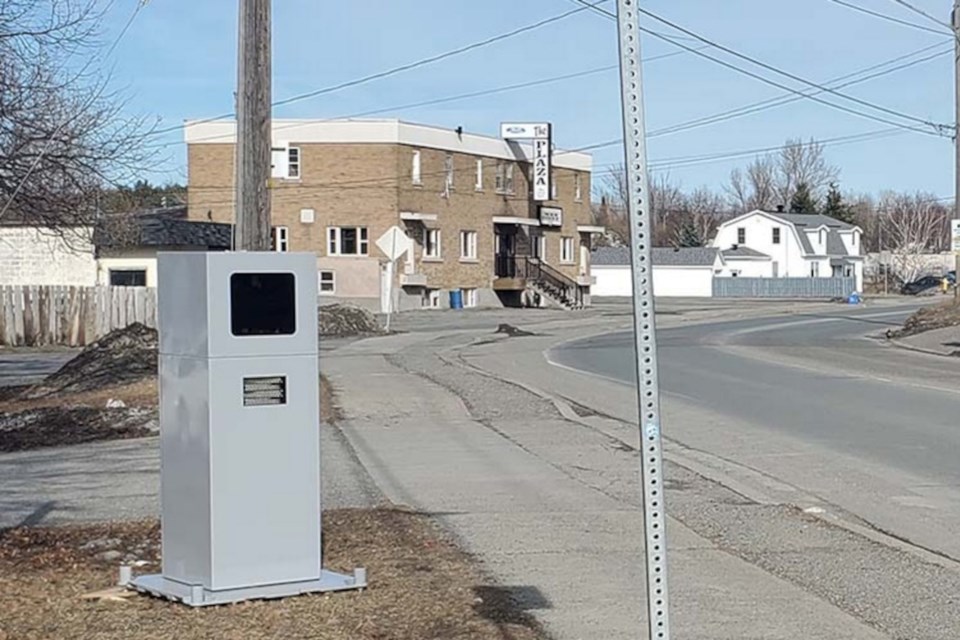
Motorists are altering their driving habits in favour of safety as a result of the city’s collection of six automated speed enforcement cameras.
They are also slowing down outside of immediate proximity to the cameras and sustaining lower speeds even after the cameras have been removed.
So describes city communications staff in sharing the latest batch of speed data around the cameras.
In addition to reiterating past findings that people are slowing down in immediate proximity to automated speed enforcement cameras, the data points to sustained speeds.
Upstream of automated speed enforcement cameras, 85th percentile speeds (the speed at or below which 85-per-cent of vehicles are travelling) decreased by an average of 14 per cent from August to December 2024.
Downstream of automated speed enforcement cameras, 85th percentile speeds decreased by an average of 11 per cent during this same timeframe.
To assess whether these changes had a lasting effect, the city conducted a follow-up review in March of this year, after enforcement had ended.
This study showed that although motorists sped up a bit, 85th percentile speed remained an average of 7 km/h lower than pre-enforcement levels.
“These results suggest that automated speed enforcement not only encourages drivers to slow down when approaching cameras, but also promotes safer driving habits that continue even after they’ve passed the enforcement zone, and even after enforcement,” the spokesperson noted.
This raw data echoes last month’s findings of CAA South Central Ontario. They conducted a survey which revealed that 73 per cent of drivers in southern Ontario slowed down as they neared an automated speed enforcement camera, and more than half (52 per cent) said they were unlikely to speed up afterwards.
This post-camera result is an improvement upon the 44 per cent of drivers who said they wouldn’t speed up post-camera in 2023, which the CAA media release notes, demonstrates “that the presence of automated speed enforcement is positively shifting driver behaviour in these areas.”
“Our research shows that automated speed enforcement continues to have strong public support and can be effective in getting drivers to change their behaviour,” CAA community relations consultant Michael Stewart said in the media release. “While speed cameras may not solve every road safety issue overnight, they play an important role in nudging driver behaviour in a safer direction.”
Last year, Greater Sudbury’s six mobile automated speed enforcement cameras resulted in 12,796 tickets being issued, which brought in approximately $1.3 million in fines.
Factoring in an allowance of $298,847 for uncollected fines and $322,387 in operating costs, the city’s net revenue was $753,003.
These funds are being used on traffic safety efforts throughout the city, including an expanded flexible bollard traffic-calming program and gateway speed limits.
(Bollards are yellow posts placed at the sides and centre of roads to narrow them with the intention of slowing traffic. Gateway speed limits slow traffic to 40 km/h and 30 km/h in school zones within a fixed area indicated by signs showing where the gateway area “begins” and “ends.”)
Camera-derived funds are also being spent on permanent traffic-calming infrastructure, such as speed humps and raised medians.
While recent years have seen the city’s budget allowing for only one traffic-calming feature to be added per year, 2026 will see the city add eight, boosted by camera revenue.
It’s anticipated that public consultation takes place this year and next, with tendering and construction occurring in 2026.
The city’s six automated speed enforcement cameras are relocated every four months as they shift through the city’s list of priority locations.
The following are the current locations:
- Municipal Road 80, Val Caron (between Main Street and Yorkshire Drive)
- Kelly Lake Road (between Copper Street and Southview Drive)
- Kalmo Road (between Main Street and Bodson Drive)
- Notre Dame Avenue, Hanmer (between Linden Drive and Oscar Street)
- Barrydowne Road (between Lasalle Boulevard and Lillian Boulevard)
- Falconbridge Road (between Donnelly Drive and Church Street
Tyler Clarke covers city hall and political affairs for Sudbury.com.