
A drone slowly rising into the sky, its camera turned down towards the group gathered below. On this day, July 22, 2024, a special Diamond anniversary is being celebrated on a hillside overlooking Gatchell.
The Big Nickel, that gleaming old reliable landmark on the Sudbury horizon, has turned 60 years old.
As the shutter (do drone cameras have those?) snaps, we are instantly transported back in time to Day One, a Grand Opening for an idea, which, for three gentlemen, would represent the City of Sudbury perfectly as our country approached its Centennial year.

On that day, 2,500 local residents and dignitaries were on hand for the official unveiling of the Big Nickel by the Canadian Centennial Commissioner, “Mr. Canada” John Fisher. This was the first centennial project undertaken by a private enterprise where the commissioner had officiated.
He dedicated Sudbury's Big Nickel to the people of the city and Canadians across the world. This moment marked both the culmination of many months of planning and the beginning of an era which would see the Big Nickel develop into a world-renowned landmark.
A band representing the Sudbury Lions Club was on hand to perform at the ceremony. As well, students from the Sudbury School of Ballet performed a dance called the "Big Nickel Twist" to a song composed by a local singing group known as the "Collins Mixers."
The story of our famous landmark and the park where it is situated begins with local man Ted Szilva. The idea of using a nickel as a symbol of the city of Sudbury came from a suggestion by John Fisher, when he was president of the Canadian Tourist Association.

Szilva envisioned a nickel being used in and around the city, in order to promote the area. It wasn't until a local artist and sign maker, Bruno Cavallo, introduced him to the idea of an actual "Big Nickel" monument and not just a two dimensional symbol, that Szilva was inspired to create the numismatic park.
The idea was put forward to the city's Centennial Committee, in 1963, only to be rejected. Szilva was a 28-year-old city fireman when he started his fight with city hall to get his dream erected.
"Mayor Joe Fabbro liked the idea. But the bureaucrats fought it all the way…(because they considered it) a crackpot idea by a city fireman,” said Szilva, during the 30th anniversary year of Big Nickel. But he was so convinced of its merit, that he decided to develop the park anyway.
Szilva teamed up with Bruno Cavallo, Cecil Fielding and John Goodearle to get the project moving forward. Together, they formed the "Nickel Monument Development Corporation Limited" to launch their ambitious and imaginative project as a salute to Canada's 1967 centennial of Confederation. It would become the nation's largest privately developed Centennial project.
Szilva was able to overcome a roadblock put up by the city when it wouldn't give him a building permit. In December 1963, using $50 as a down payment (out of a $1,000 total price), he purchased 17 acres of land from property owner Walter Holditch, just outside the city limits. “I built it three feet outside city limits,” said Szilva.
Here, they would develop their park. Ideally situated on a high, rocky mass of land just beyond the city's western limits, in close proximity to Highway 17. The park overlooked Inco’s Copper Cliff smelter, offering a splendid view, not only of the City of Sudbury, but also of the (then current) three giant smoke stacks, and the pouring of slag.
With the acquisition of this property his monumental plan, which originally included the construction of 18 giant coin monuments and a Canadian one dollar bill, began to take shape. The monuments were to be the main attraction of the park but there were to be other features as well: a nickel museum to house information pertaining to nickel, its discovery, development and uses; a model railroad which children could ride around the park; a world-class coin collection and an authentic model mine where tourists could catch a glimpse of what the life of a miner was all about.
Szilva, as originator of the park project, took up the positions of president and chairman of the corporation. Vice-president of the company was Cecil Fielding, a well-known Sudbury businessman and respected political figure.
Bruno Cavallo was the artistic force of the group. A local Sudbury artist and owner of a sign manufacturing company, he became secretary-treasurer. It was Cavallo who was responsible for the beautiful artistry and workmanship involved in the creation, design and construction of the Big Nickel, along with the other monuments which were eventually erected at the site.
The construction of the Big Nickel took place in Cavallo's workshop. Using a piece-by-piece construction, it required most of the winter of 1963 and spring of 1964.
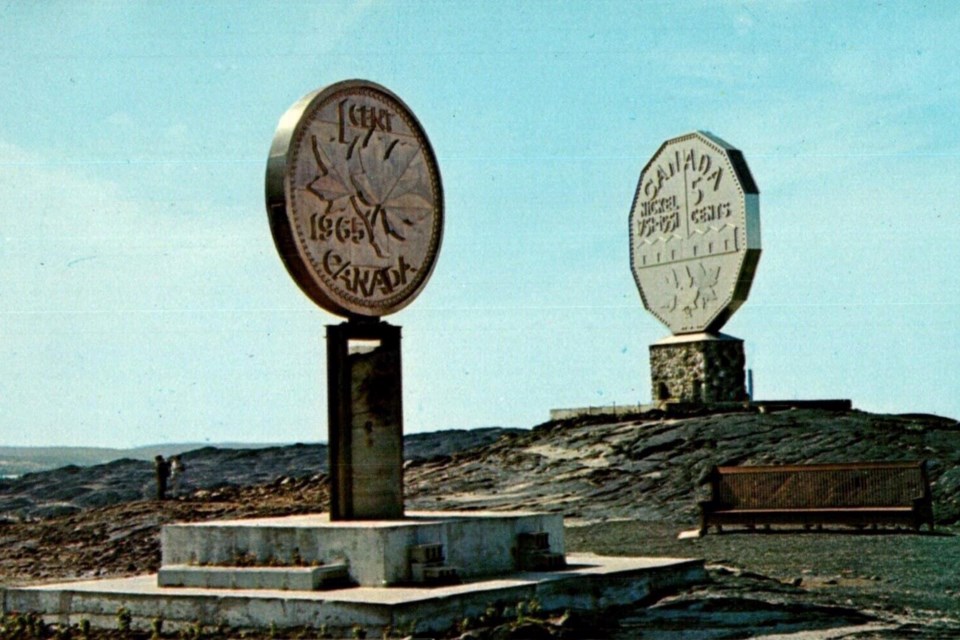
Measuring 30 feet in diameter and 24 inches thick, the "Big Nickel" itself was modelled after the 1951 Canadian five cent piece. The '51 nickel was chosen because it commemorated the 200th aniversary of the isolation of nickel as an element. On the obverse was a portrait of King George VI while the reverse design featured a representation of a nickel refinery.
It was built to exact specifications, right down to the 244 dots (denticles) along the edge. The King's face alone measured 24 feet and was made from paper thin stainless steel which was filled and fused to the rest of the structure. The outer steel layers covered an inner core made of wood.
The monument was perched on top of a 12-foot-high base, composed of rich ore-bearing rock and stone found in the Sudbury basin. Two hundred tons of concrete went into the base which supported the Big Nickel.
In the ornamental stonework, a colorful effect was produced by combining white quartz from Lake Penage, pink quartz from Alban, and chunks of sulphide ore from a Sudbury district mine. Its overall design was an awe-inspiring reminder of the area's ties to the mining industry.
At the beginning, a souvenir shop was located beside the Big Nickel, housed in a mobile trailer. A wide variety of souvenirs and gifts could be obtained at the shop, many of them featuring small chunks of Sudbury district ore.
To raise money for the development of the park, souvenir medallions of nickel, copper, silver and 24-carat gold were manufactured. The gold medallions sold for $175 each, the silver for $8 and the nickel and copper ones for $1.25. All show the Copper Cliff smelter on the face and the Big Nickel on the reverse. And how much for the Big Nickel? Construction of the mammoth model, according to Szilva, cost about $35,000. (Give or take a Nickel…)
By the end of 1964, another project, this time a replica of the 1965 Canadian one cent piece was in the works. The monument was christened the "Fantasy Copper" due to the fact that Fantasy Copperware of Canada, had been the sponsor to the endeavour.
It was produced, of course, by Cavallo, and measured 10 feet in diameter and 12 inches thick. It was mounted on a very unusual base, an eight-foot drill core, three feet in diameter, from the Levack mine. The platform and steps were made of flagstone found in the Sudbury area, intermingled with copper-bearing rock samples.
A gala ceremony was held on May 14, 1965 to unveil the artwork, officiated by John Diefenbaker, then leader of the opposition Conservative Party (interestingly, John Fisher, who christened the Big Nickel, was special assistant to Diefenbaker when he was prime minister). Diefenbaker told the audience of several hundred that the monument was "the most impressive monument to our country I have seen in any part of Canada.”
Sudbury Liberal MPP Elmer Sopha was the Master of Ceremonies for the occasion, while Mayor Joe Fabbro was on hand to deliver a short speech. The Copper Cliff Highlanders provided music to entertain those on hand (a far cry from the “Nickel Twist” of the previous year).
And since these giant coins told of the mineral wealth of our area, what could be more appropriate than to have an actual mine right in the park?
In May 1965, a model mine was opened for public viewing, built by J.C. MacIsaac for $65,000. The only operational model mine in North America, it became the main draw at the park. Visitors entered the headframe and were transported down via cage and elevator, sixty-six feet underground leading toward 150 feet of tunnelling (with cross-cuts, raise and compressor room).
They were treated to a tour of the attraction which featured an actual mining simulation of equipment and conditions, similar to what would have been found at an operational Sudbury mine around that time.
Actual exposed ore bodies added to the authenticity and appeal of the mine. In later years, the tunnelling was increased to over 500 feet, thanks to the help of the Department of Mining, Geology and Industrial Engineering at Cambrian College.
A popular feature near the entrance to the headframe was the "Big Nickel Jail.” Szilva had purchased the old bars and doors from the Sudbury Jail at the time of its demolition in 1968, and had them installed at the park.
Visitors could then be photographed in their "cells" at the Big Nickel. A number of items including a slag pot, drills and a 100 year old compressor added to the authenticity of the mining environment which had been created.
By the end of the 1960s, three more coin memorials, which had been in the planning stages for some time, were erected. A replica of the 1965 U.S. penny, dedicated to the "memory and ideals of Abraham Lincoln" measured 10 feet in diameter and twelve inches thick when completed.
This was identical in size to the replica of the Canadian $20 gold piece (Finished in gold leaf) which was raised, in 1968, onto a perch resembling metal spider legs.
Another American coin, this time featuring a replica of the 1964 Kennedy Half Dollar, stood over 20 feet high and 18 inches thick when completed. It was supported on an impressive 15 foot pedestal of marble and stainless steel accompanying a glass enclosure sheltering an eternal flame (replicating the deceased President’s grave at Arlington Cemetery in Virginia).
By 1970, it was reported that the first several years were the best for tourism at the Big Nickel. The Numismatic Park reported 100,000 visitors a year, peaking in Canada's centennial year, when 130,000 toured the site.
It was evident that the Numismatic Park was well on its way to becoming a major tourist attraction. As its owners wrote in a tourism pamphlet touting their amazing oasis of fun, “It is hoped and firmly believed…that the fame of this park and the enthusiasm of all who visit it, will continue to grow, just as the park itself continues to grow. May it be a constant source of pride to all Canadians…an oasis of friendship and good will for all citizens everywhere in the world.”
But some obstacles still stood in its way. Getting indoor plumbing at the site was apparently a tough task. The city wouldn't allow city water services to be installed.
"I had to build outhouses,” said Szilva. When he informed the city that tourists were leaving Sudbury wondering why there was no indoor plumbing at its most famous monument, he got the sewer and water service he needed, “I shamed them into it."
Even so, site improvements were made gradually along the way, including: easier road access, enlarged parking lot to accommodate the tourist influx (with free parking along with free admission) and a new souvenir shop were constructed.
A planned addition to the park which never came to pass was the Sir Winston Churchill 5 Shilling Coin Memorial.
The replica of this coin would have been constructed of stainless steel, with a diameter of 12 feet, and a thickness of 14 inches. It would have been supported by three granite pillars, 10 feet high, and each pillar would bear the symbol and description of one of Sir Winston's three greatest attributes and contributions to the world.
It was also hoped that a Drive-In Type restaurant would also be constructed to serve visitors from the beginning by the 1965 season. Lunching in such surroundings would, no doubt, have been a memorable experience for tourists.
Unfortunately it never came to pass, though many a tourist still had the option of partaking in another Sudbury tradition at the nearby Deluxe Drive-In restaurant.
The miniature railroad in the Park was built to honour Tom Flanagan, a blacksmith who was working with one of the construction crews of the Canadian Pacific Railway employee who accidentally discovered ore in the Sudbury area in 1883. But, of course, the children just loved riding the train.
The engine pulled two cars and a caboose, and circled the entire park, providing its passengers with a bird's-eye view of the unique surrounding area. The children were also delighted to play on the lunar landing module (a half-scaled replica installed after the 1969 moon landing), a carousel, and trips to “Snoopy's snack bar” for refreshments.
On June 28, 1975, a new celebration took place for the first major, non-numismatic attraction at the now 11-year-old park. This was the dedication of the Wampum belt and Brotherhood of Man Monument, which consisted of two totem poles joined by a wooden wampum belt.
The totem poles were a reflection of the brotherhood of man as seen through the history of the Haida of British Columbia and of Shaman Chief Kitpou, who came to Sudbury to supervise the completion of carving (with the help of volunteers) and the erection of the poles.
The totem poles were 30 feet and 34 feet high and were cut and only partially carved in British Columbia.
Ropes to pull the poles into place were handled (mostly) by local children and following their erection, Chief Kitpou spoke on the Haida’s heritage and the meaning of the totem poles. Approximately 1000 people were on hand for the ceremony which also featured ceremonial dancing by some Haida children and the dedication of the plaques of the Wampum Belt.
Unfortunately, all good things come to an end, or in this case, move on to a different phase in their existence. In 1981, Szilva sold the tourist attraction to the Sudbury Regional Development Corporation, which was in the midst of preparing plans for what became Science North.
However, by 1984, the year of its opening (and the Big Nickel’s 20th Anniversary), Science North was confronted with a problem. The wear and tear of the Northern climate had taken its toll on the monuments and they required costly repairs.
Instead of embarking on a major maintenance program to refurbish the mammoth coins, it was decided simply to dismantle them. This decision was made based on two considerations: cost and mandate.
In Science North's view, it was preferable to channel any available funds toward other avenues. The operation of a numismatic park was never their intention.
Jim Marchbank, Science North's chief executive officer, also said at the time: "The reason we acquired the Big Nickel Mine was to give people the underground mining experience…We wanted to focus on mining, not on what was the former numismatic park."
It was believed that operating a model mine would offer the “best opportunity to develop a significant portrayal of the history, technology, and socio-economic impact of mining in the North."
"When Science North took over the mine, a decision was made to change the focus of the mine away from a numismatic park into one that looked at the mining technology and mining heritage of Northern Ontario," stated Pat McCauley, marketing officer with Science North, in the mid-1990s, when the question of the lost monuments was posed.
“While the rest of the coins were removed, the Big Nickel itself remained as a Sudbury landmark and as a monument to Sudbury nickel mining heritage,” McCauley continued.
Four of the monuments - the Lincoln Penny, Canadian Penny, Gold Coin and Kennedy 50 cent piece - were then disassembled. Daryl Potvin, physical services manager at Science North, stated that it cost $12,000 when the Big Nickel was finally refurbished and a similar cost would have been incurred had they decided to maintain the other monuments as well.
The model railroad was also dismantled around this time, since it also was in need of costly repairs and no longer suited the purpose of the owners.
A railway car which had been brought to the park in the early 1970s was also in a state of disrepair, according to Science North sources, but it was restored to use as a mining rescue car. The rescue car was kept in operation for two years until it was vandalized to the point where Science North was forced to shut it down. It then remained at the park to be used for storage purposes only.
The original headframe of the Big Nickel Mine was demolished to make way for a new entrance, and the underground drifts were increased again in size to 1,200 feet. Other additions included a cut and fill stope, an undercut and fill stope, a timbered drift, a blasting display, a mechanical room, a refuge station, an underground garden and guided tours. The gift shop and snack bar building were expanded as well.
And what about the totem poles? Ted Szilva once said that he'd been asked many times before about the totem poles and wampum. "I've often wondered that myself," he would say. So, unlike the coins, this question remains unanswered to this day. (Maybe one of you out there knows?)
Well dear readers, 60 years ago, the sun rose and cast its gleaming rays across the stainless steel facade of the only nickel that you would find difficult to carry around in your pocket as loose change. O
ver the years, it gained and then lost a few numismatic siblings (and the watchful gaze of two totems) while continuing to amaze and educate generations of children and their families.
Now it’s your turn to amaze and educate (and entertain) your fellow readers with your memories of the first 20 years of the Big Nickel and the Canadian Centennial Numismatic Park.
Share your memories and/or photos by emailing them to Jason Marcon at [email protected] or the editor at [email protected].
Jason Marcon is a writer and history enthusiast in Greater Sudbury. He runs the Coniston Historical Group and the Sudbury Then and Now Facebook page. Memory Lane is made possible by our Community Leaders Program.