
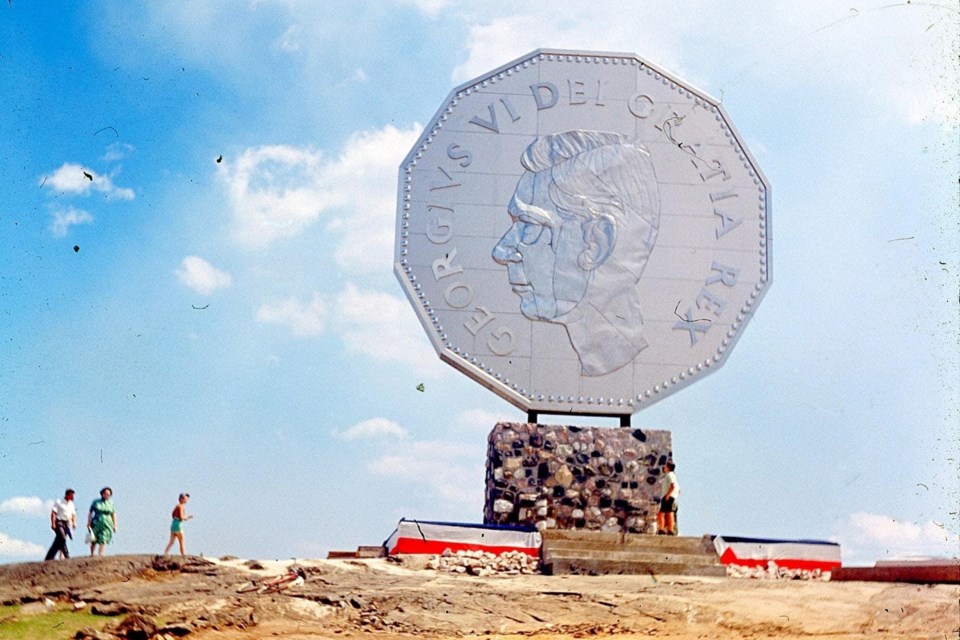
As the old saying goes, “a Penny for your thoughts?” Well, here in Sudbury, I say (especially after all of the great memories you the reader sent in), “a Big Nickel for your thoughts?” is infinitely more appropriate.
Now let us climb into the elevator and journey down into the past and immerse ourselves in your memories which were mined deep in the cavernous Big Nickel Mine during the first 20 years of the Canadian Centennial Numismatic Park.
A few readers came out of the woodwork (metalwork?) to let us know how near and dear to the heart this project was to different people through their involvement in some aspect of planning and designing parts of it.
Local history impresario (and author of two photo-rich books on Sudbury history), Ray Thoms, wrote in to reinforce his uncle’s important contribution to the Big Nickel’s history.
“Bruno (Cavallo) was my uncle,” he wrote, “and I actually worked on the Nickel when I worked for my uncle while it was being developed in the Cavallo Sign Shop which no longer exists on Albinson Steet in the west end of Sudbury. (Although) I…did some work on the nickel…it was mainly Jim Burnett who built it.”
Another reader, Jim Dunn disclosed to us in a comment that what became the Big Nickel Mine itself originated from within his family home. “My Dad drew the plans for this (Big Nickel Mine),” he wrote, adding that there was an apparent pay dispute.
Reader Greg Muldoon dropped us a line to let everyone know the originator of the Big Nickel locomotive. “Al Ryan, a Sudbury firefighter at the time, built the locomotive for the train. He passed away a few years ago,” he said.
One final comment came to us from a place near to the heart of the Big Nickel, Natalie Cresswell Szilva (Ted Szilva’s daughter-in-law) left us a comment speaking specifically about a postcard displaying the very train mentioned above carrying a group of people. She let us know exactly who is featured in that promotional photo.
“That is Ted, my father-in-law,” she said. “He is holding my husband Jim and his eldest daughter Rosemary is standing beside him. The other little boy in blue is Jim’s cousin John. Other family members filled the seats in the cars behind them.”
A couple of our readers wrote in to mention that they were present at the official unveiling ceremony way back in 1964. Deborah Knuff was in-depthly involved as a member of one of the performance groups.
“I was proud to be part of the opening ceremony, along with other dancers from the Sudbury School of Ballet,” she wrote enthusiastically.
Vic Thériault was there in the crowd for the grand opening (though I would imagine that one of Sudbury’s resident Bluez Brotherz would be performing if this occurred today).
As he recalls of that hazy day, “We pedalled up the steep access road off Dean Street. It was a beautiful sulfur day.”
Another one of our readers found himself in the thick of things at the unveiling of the Wampum belt and Brotherhood of Man Monument on June 28, 1975.
“I was there and part of the crowd that raised the Totum pole into place by rope,” remembers reader Bill Green. He was one among many hands on the ropes (mostly local children) playing totem tug-of-war to pull the poles into place.
Working under the shadow of the Big Nickel was such a memorable part of some of our readers’ (or their family members’) lives, that even 50-60 years later, they can still tell us about it with giddy enthusiasm.
Glen McQueen’s “dad used to repair the souvenir shop and (I) remember him building Ted Szilva’s office (or rebuilding it) And repairing the Bic Nickel dots around the edge with stainless steel pot lids.”

Elaine Dahl shared a photo with us of a model Big Nickel made by her family to be sold to tourists as a souvenir from the early to late 1960's. As she described it, “this is a plaster of paris Big Nickel (that) my Mom and Dad, Vince and Kay O'Driscoll, made in their basement on Dufferin Street and sold in the Big Nickel gift shop. My job was rubbing the gold letters.”
A couple of our readers most likely sold some of Elaine’s parents’ Big Nickel models. Susan Darling was initiated into the working world as her “first summer job was at the Big Nickel souvenir shop (in) 1964” She remembers it as “just a little shack at that point (with) one monument.” While Lauria Raymond “worked in the souvenir shop…I am guessing 1967-1968.” And, she also recalls that “(former Mayor) Jim Gordon’s brother was a tour guide in the mine” around the same time.
One final reader, Michael Sabo, liked the work environment so much that he “worked there for two summers. (It was a) great job driving the train and working in the mine shaft.” (No word from Michael on whether he worked each job in consecutive years or at the same time).
As it was in the past with the slag pour and still remains to this day with Science North (and, of course, Dynamic Earth), which have both been written about in previous columns, the Canadian Centennial Numismatic Park was a requisite stop on the tourist circuit. Lena Samson claims (and rightly so), “It was THE tourist attraction in the old days.”
And, Lynda McIlmoyle Joanisse’s memories of those “old days” are most likely similar for most locals who entertained out of town guests, “We had so much fun there as children when our cousins would come to visit! I remember the gift shop and cool souvenirs.”
But, local residents did not only visit the Big Nickel (and its numismatic brethren) when they had guests to show it off to, it was also a pre-requisite amongst the school system to bring students to some learning and fun (and frights too depending on what scares you).
Julie Snider “went down (into the Big Nickel Mine) on a school trip…if you had any phobias, you sure as heck didn't show it.” She also recalls running afoul of staff, as she “remember(s) all of the kids collecting bits of pyrite, and the tour guide getting angry at us.”
Unfortunately for reader Pam Penner, she did not heed the kind of advice imparted by Julie above. “I remember we had a class trip there (the Big Nickel Mine) in Grade 5,” she said, “but I went down and then right back up again. Not for me!”
Under different circumstances (and with a different outcome) Melanie Jarratt also went down into the Big Nickel Mine. As she enthusiastically reminisced, “I went underground with my dad, who worked at Inco. He brought me, his sister, my cousins. It was a whole family affair. We went way underground. The elevator seemed to take 20 minutes and there was like a cool office down there and I thought it was really neat.“

Barbara Fisher remembers a popular feature near the entrance to the headframe, the "Big Nickel Jail.” Not only could visitors be photographed in their "cell" at the Big Nickel, but, as Barbara wrote, “We were all paying to put our bosses in jail, (unfortunately) buggers wouldn’t keep them.” Though, she did add that it was a “great way to raise money for charity.”
Lanah-Lee Hart-Chevrier, with perhaps an unknown knowledge of its realism, “was so scared of that jail! I thought it was real.” And, in fact, it was (sort of) real, as Szilva had purchased the old bars and doors from the Sudbury Jail at the time of its demolition in 1968.
Unlike many tourist attractions, the Big Nickel property being as wide open, and non-fenced in, as it was, became an extension of the play area for the children of the neighbourhood. A reader on our website, Gary Belanger, who was born in 1962, recalls “prancing around the displays as a young boy.”
Another reader, David Loyst, made the Numismatic Park a part of his daily ritual during the school year. As he wrote to us, “I used to hike up to the Big Nickel at lunch hour from Gatchell Public School.”
For Ron Gudel and his friends: “That was our playground growing up. As kids, we were able to climb up and down those steep rocks no problem at all…I grew up in Gatchell a few blocks away from the Big Nickel, we used to sneak up the hill so we wouldn't have to pay admission. Great memories, climbing up steep rocks and always on the lookout for staff. There used to be a gift shop that was always fun to look around as well. I remember inside there were postcards as well as rock and mineral samples for sale.”
Many of our commenters brought up the daredevil streak of their youth, as the road to and from the Park held as much (if not more) fascination to them than the contents of the Park itself. Dave Genereux sparked the discussion with his first comment, “someone needs the find a picture of the exit road from hell on the otherside of the hill.” To which he added, “I think going down was 60 per cent of the fun of visiting there…I swear my Dad just loved stopping just at the very top to scare the crap out of us kids in the back.”
Reader Jamey Burr began reminiscing with a comment that belied his age at the time, “I was seven years old when it first opened and felt that it really put Sudbury on the map.”
But, he quickly pivoted to memories which would make Evel Knievel proud, “A few years later, my friends and I were able to ride our bicycles to the site and challenge the steeply pitched hill at the exit of the complex. We all bragged all the way over about doing the hill without brakes, but always realized a few meters into the descent that brakes were available to us for a reason.” He ended with a hope that “maybe one of your readers did it without braking and survived to tell the tale!” (Well, if anyone out there did, now’s the time to tell the whole of Sudbury)
Clearly though, our last two readers were not this person. Barbara Fisher “remembers going up there on a motorcycle and coming down the steep exit, first time on a bike had my leg in a cast and almost had a heart attack. Never did that again.” (That was probably a good idea).
While Doug Williams and his friends “used to pedal our bikes up the front entrance and get the living bejesus scared out of us going down the exit road into Gatchell.”

In the spirit of the Facebook group “Sudbury Then and Now” (where the majority of these reminiscences originated), many readers bridged the past with the present, to highlight the changes (for better or worse) in and around the Park.
Reader Garth Wunsch remembers the scene around the original Numismatic Park and stands amazed today at how things have changed. In comparison to the virtual moonscape at the time of its conception, Wunsch fins there to be “such a landscape contrast, (in the present-day) approaching from the west, the forest almost hides the nickel.”
Steven Vallarsa’s commentary focused on the changes made to Big Nickel itself, as he states that he “prefers (the) original stone pedestal to the modern one.” The ornamental stonework, included a colorful effect produced by combining local white quartz, pink quartz, and sulphide ore, in an awe-inspiring reminder of the areas ties to the mining industry.
Many of our readers lamented the loss of the Big Nickel’s numismatic siblings for many different reasons. Though, Richard Foers put it most succinctly, in reference to the Big Penny, as he stated that “the penny is much more beautiful. Just the design of the coin itself is more attractive.”
A couple of our readers pointed out that the base of one of the coins still survives to this day, though not in a place where you would expect it.
Rino Carniello wrote that he “believes this base…is on a property just outside of McKerrow…Just on the highway.” This was confirmed by a second comment, on the website, stating it “can be seen on Highway 17 West between Sudbury and Espanola, in the front yard, usually with hanging plants on it!”
As for the rest of the coins on display not named “Big Nickel”, those four monuments - the Lincoln Penny, Canadian Penny, Gold Coin and Kennedy 50 cent piece were disassembled after the takeover by Science North in 1984. And, as Terry Closs recalls “most/all of the other coins were dismantled and discarded into a NIM bin behind the former Greyhound garage on Dean Street in the early eighties.”
Now, before we close out this article. Remember in the previous one, I mentioned a song written specifically for the Grand Opening of the park? Well, here it is (and maybe someone out there could give it a 21st century twist).
THE BIG NICKEL
If you ever travel to Ontario
Then Sudbury will be the place to go
The crossroads of the North, they all agree,
Where the rocks are bigger, and the air is clean
And for miles around can be plainly seen
The big, "big nickel", bigger than you and me.
CHORUS:
The big, big nickel known from sea to sea
The big, big nickel you should come and see
The big, big nickel makes you understand
Why everybody in the land thinks that Canada is grand!
Oh there's nothing like it, nowhere can you find
Another like it... it's just one of a kind
A five-cent piece, that's bigger than a tree
It's a symbol of a hundred years of pain
To make a nation free for every man
The big, "big nickel", bigger than you and me.
And when you look about you from its windy hill
And see the smokestacks that are taller still
Taller than the tallest you can see
It makes you realize how much a nickel's worth
These people tore this metal from the earth
The big, "big nickel" belongs to you and me!
In closing, thank you to everyone who shared their memories and their photos with us, and thank you most of all to the gentlemen that started it all.
As stated in a comment left on our website, “It's amazing the amount of time, effort and money Messrs. Szilva, Fielding and Cavallo spent over the years to create such a park on their own (and) how much the park was truely a labour of love for them. An opportunity to educate people in a fun way, incorporating local resources, people and culture.”
Happy 60th Birthday, Big Nickel!
See you here again in two weeks for another trip back through time.
Jason Marcon is a writer and history enthusiast in Greater Sudbury. He runs the Coniston Historical Group and the Sudbury Then and Now Facebook page. Memory Lane is made possible by our Community Leaders Program.