

A university is more than just its buildings. It’s more than lecture halls and faculty offices, sports fields and libraries. A university, at its heart, is the sum of its people, their hopes, their struggles, their triumphs, and the ground on which they chose to plant those dreams.
For Laurentian University, that ground was a rugged, forested slope overlooking the shimmering waters of Lake Ramsey. And from that rocky ridge, a remarkable institution emerged, idea by idea, brick by brick, person by person.
Today, as our readers, both graduates and former staff, reflect on their time at Laurentian, they return not only to the physical campus but to the spirit that animated it from its earliest days.
“Optimism for what the future held was at its height,” the late Charles Booth once observed, capturing the electric energy of those formative years.
From pool halls to purpose-built halls

The 1963-64 academic year marked a major milestone: Laurentian’s move from makeshift downtown classrooms to its purpose-built campus on Ramsey Lake. The transformation, both physical and symbolic, was not lost on the students and faculty.
“We observed with keen interest and deep pride as the buildings mushroomed into existence on the formerly secluded, mountainous slope of Lake Ramsey,” wrote Ruth Petrenas, co-editor of that early yearbook.
“The initial action of laying the foundations impressed upon us the meaning of the firm foundation of a university education. In the next phase of construction, we saw the rise of the naked, massive, steel girders; these recalled for us the importance of truth in a materialistic world and of unity as the greatest strength. Finally, the clothing of the strong girders with mortar and brick symbolized our shaping, both in character and personality, by the artisan, Laurentian University.”
This shift also marked the end of the "pioneer days," when classes were scattered throughout the “campus” of downtown Sudbury - in pool halls, hardware stores, theatres, even former funeral parlours.
Paule Deneau recalled the trials and tribulations endured by the teaching staff and students prior to the consolidation at the new campus. “Until that time my young ex taught university students in various venues including stores, above pool halls, etc.“ before they moved to London in 1964, just as construction on the new campus began.


Reader Peter Désilets joked about the previous life of the original Huntington location, in the former Jackson & Barnard funeral home on Larch, “I hope you're not suggesting that this academic institution promoted a ‘Dead Poets Society’…how ghoulish!”
Alan Arkilander remembered a former law partner attending classes at the University of Sudbury when it was in the Grand Theatre building. While “my brother was downtown,” said Jim Dunn. “I was on the ‘real’ campus, first year.”
And Jack Hedman? He proudly claims his place as a member of Laurentian’s first graduating class on the new campus.
Susan McKane referred to her time at Laurentian as “three happy years on the hill.” In fact, her family of scholars were there from the very beginning, watching it grow, as they studied at the school both before and after it developed at its current location.
“My sister attended the Huntington Campus on Larch St, and my brother and I and my future husband enjoyed the first years on the Ramsey Lake campus. Laurentian and its affiliated colleges have played such an important role in the life of the north…may it continue.”
A campus of family

The Laurentian campus, as it grew, became a home. Some readers recall not just studying or working there, but living there. Wendy Newbury, Susan McKane’s sister, while only seven years old at the time, lived with her family “in the ‘new’ Huntington residence before there were enough students to fill it.”
Their father, Dr. Ed Newbery, then principal of Huntington University, was a guiding figure for many and remembered fondly by former students. He was “one awesome man who shared his family and his ‘dad stature’ with many of us,” said alumnus Andrew Vujnovich.
Newbery’s legacy extended well beyond administration of the school. In the 1970s, he helped launch Laurentian’s Native Studies program and took education into penitentiaries—pioneering work in equity and access.
He was named Sudbury’s Citizen of the Year in 1973, made a member of the Order of Canada, and remembered fondly in April 1989, at his 80th birthday, where friends announced the release of a book of essays in his honour titled Challenging the Unconventional.
The essays explored four areas of the human condition: social justice, ecumenism, peace and spirituality from an unconventional perspective.
Acknowledging the generosity of hundreds of friends and colleagues, Newbery remarked at the time, “The academic and spiritual community of college has been an enrichment of my life that I can never express."
A place shaped by many hands

Now, Laurentian’s story isn’t just about professors and students, it’s about the builders too. And, a few of our readers shared with us that they (or close family members) were involved in developing Laurentian on the physical side.
Jim Beckerton’s father operated the crane that hoisted steel girders into place. Pietro Vettoretti, father of Ido Vettoretti, shaped the stonework on the classroom buildings. And, Lenny Piché “was part of the crew that installed the front entrance of one of the student residences that were constructed” in the 1970s.
These workers helped create the buildings that students like Susan Woods would affectionately give nicknames to, such as calling the Faculty of Arts and Humanities building “The Bowling Alley.”
Geoffrey Lee, reflecting on early plans, noted that “the affiliated colleges were to have had more structures based on the ‘as built’ designs” which were originally envisioned, but funding cuts in the early 1970s halted some of that growth.
As well, a later planned roadway from the Lo-Ellen Park area to the location of the Physical Education Department became today's Loach’s Walking Trail after residents objected to traffic concerns.
In reminiscing about the need to consolidate the federated universities onto a single campus, reader Colette Leroux (with tongue planted firmly in cheek) gave us her take on the real reason, “I wanted a new place, so they built in front of the lake and (it) was complete for me to start working in 1964.”
Remembering the heart of the campus

From student life to cherished staff, readers spoke often about the people who gave Laurentian its soul. Former staff spoke of the enjoyment which they derived from their jobs.
One reader, writing under the name Doglover62, shared how her mother, Annette “Red” Ratelle, worked nearly 25 years in the library. Known for her red hair and generous spirit, “she loved working at the university and loved helping all the students,” she recalled. After her passing in 1994, a photo of Red “was put up on the wall in the main library” in tribute.
She also followed in her mother’s footsteps for a time by “work(ing) in the mail room and different summer jobs in various offices on campus.”
Former registrar’s office employee Jacquie Roney remembered “and enjoyed the diversity of my job” which “made it very busy and the days went by quick” and the joy of working under Mr. F. Thibodeau. “My boss was a fabulous person to work for,” she added.
Noreen Barbe treasured her time in the Office of the Director of Services, especially the friendships formed with international students. “So appreciate the adventurous life moments we have had from meeting students and the many International students who have given me wisdom, and many personal friendships.”
For Wally Moran, memories include time as a swimming instructor and lifeguard at the pool. While for Paul Haynes, Rainbow Routes’ historical tour impresario, lived on Ramsey Lake Road in an old farmhouse, it is the “many hours playing and hitting balls against the backboard at (the) tennis courts. The Ben Avery building was a workout and quick shower. Student Street was laundry and the Great Hall a meeting place.”
The pub was also a major hub of social life. “We sure had a lot of fun,” said Andre Lamoureux. Col Ette, a 1990 graduate, remembers that “the pub and the many social events and dances on campus” adding that “sadly, it's very different now.”
Threats to identity and the fight to protect it

Although many former Laurentian students and faculty remember the recent scandal involving the university’s bankruptcy, there was another time that the city of Sudbury nearly lost Laurentian to an expansion and name change.
Laurentian’s identity faced a challenge in the 1980s, as it reached its 20th anniversary, when a government committee led by Harry Parrott, former minister colleges and universities, recommended merging it with its other northern affiliated colleges under the name "Champlain University."
The plan proposed a single bilingual institution with campuses in Sudbury, North Bay, Sault Ste. Marie and Hearst.
Parrott believes that “the problem of keeping northern students in the area to receive their education could be better combatted by the four campuses working together to that end.”
In a brief presented to the Ontario Council on University Affairs, the trustees at Algoma University College argued that a larger university “would command greater respect and would attract more students and highly qualified faculty.”
The trustees even went so far as to propose a larger university of Northern Ontario incorporating Thunder Bay's Lakehead University as a possibility.

Laurentian’s alumni pushed back hard.
Engeline Baas, president of the alumni association, called the name change a “needless affront” to the university’s legacy. “We want a written commitment that the name won’t change,” she said. Backed by 15,000 graduates, petitions flooded in.
President Henry Best echoed the concerns: “There is no point in going through restructuring if we don’t end up with better results and better service.” The name, he argued, represented more than geography, it represented a vision and a community.
In the end, Parrott’s doubts were realized as the committee's recommendation became "just another report.” And, the name and the school’s commitment to our local community remained.
A campus changed, yet familial
In the early 1980’s, Laurentian alumnus Raymond Franchetto explained what it was that made his Alma mater special for its students and faculty. “The uniqueness of Laurentian University comes, not only from its location, but also its size. The small size offers the type of personal contact and learning environment which cannot be found at larger universities.”
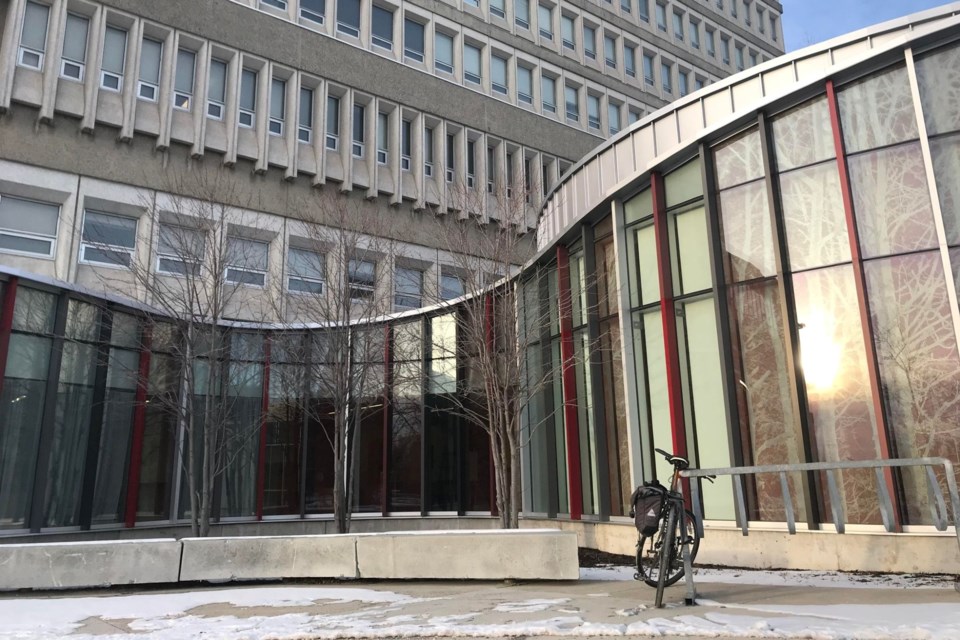
Many who read our earlier story and viewed the accompanying photos were amazed at how much the campus has changed, and how much remains the same.
“It’s so much smaller than it is today,” said Gord Foerter. “But the surroundings are still beautiful and quite amazing.”
Lisa Marie added that “it looks so different than it did in the late 80's when I attended or even…the last time I was up there 10 years ago. It has more buildings and the newer Indigenous Sharing And Learning Center is beautiful.“
Yvette Beland who “worked there from 1966 to 1974. First in (the) Physical Plant and Planning then in Treasury” laments that “things were so much simpler then before they got bigger.”
Gabrielle Lavigne, who worked and studied at Laurentian for approximately 25 years, called it “my home for most of my life” as she “met, worked and studied with incredible caring and dedicated people.”
And, despite the recent financial turmoil, she urged readers to remember that Laurentian “has been home to many scholars and helped build this great city of ours by educating many of its citizens.”
Sudbury.com’s own Heidi Ulrichsen, who attended Laurentian University from 1999-2003, graduating 40 years after Jack Hedman’s initial class, captured the enduring appeal of the place:
“I love the fact that I was on a first name basis with my profs (and still talk to some of them). I love the nature on campus - seeing foxes sauntering around nonchalantly and hearing spring peepers after my last exam in the spring.”
This sentiment is very much similar to that felt by Jennifer Robson (third-year student in 1981) who wrote at that time: “The thing I shall remember most about Laurentian is that I could walk down any hill and see a familiar face. I've had the pleasure of meeting people from all faculties, be they faculty or students, and I've made friends to last a lifetime. I like the 'outdoorsy' feeling that the campus exudes. There are five or six lakes in the immediate area, and fresh air which is a rare commodity in this world. If the winter is a bit long, it is also great for skiing and snowshoeing and snowball fights.“
A legacy

Well dear readers, we have come to the end of this week’s column. From its first foundation stone to the debates that shaped its identity, Laurentian University’s history has been forged by thousands of individuals: builders, professors, students, staff; each leaving their mark.
As Ruth Petrenas wrote in the first yearbook published at the new campus, “the scenic beauty of her surround will match, if not surpass, that of any other Canadian university (and) although, Laurentian is appealing to the eye, her inner beauty is still more radiant. She has cultivated this beauty through her high strivings, co-operation and sacrifice.”
President Stanley Mullins, in a 1967 message, reminded students that they were part of a bicultural experiment unlike any other in Canada. “Use what you’ve learned,” he said, “not for self, sect, or race, but for Canada.”
And, 65 years on, the Laurentian community, scattered but still connected, continues to answer that call. See you again in a couple of weeks for another stroll down Memory Lane.
Jason Marcon is a writer and history enthusiast in Greater Sudbury. He runs the Coniston Historical Group and the Sudbury Then and Now Facebook page. Memory Lane is made possible by our Community Leaders Program.