

Storm season is approaching, and it’s time to get ready. We need to be prepared for wind, rain, or snow.
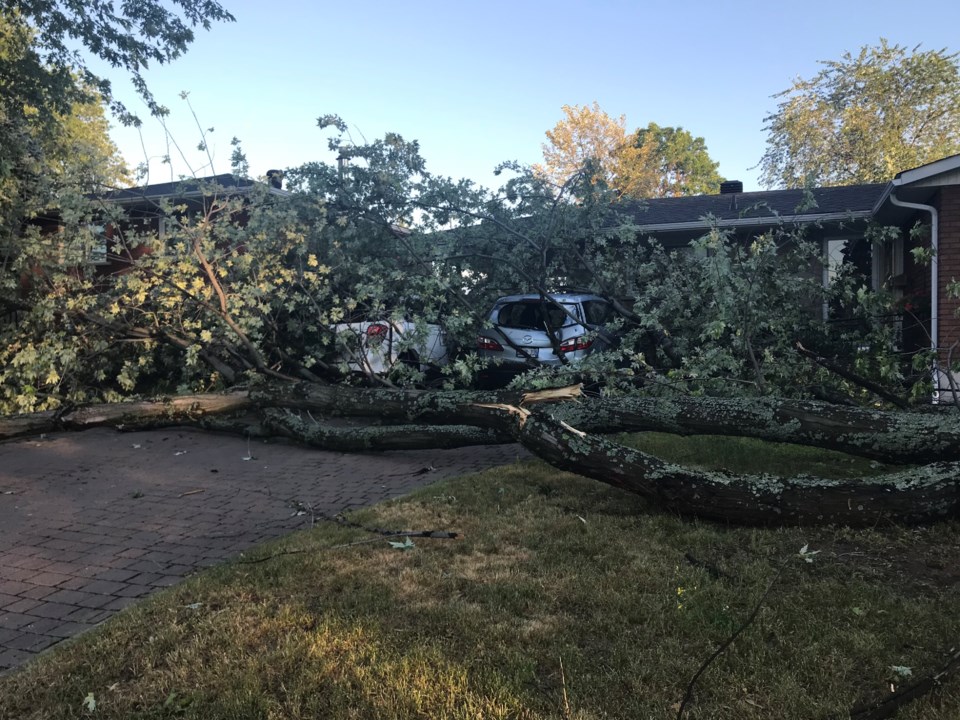
While tornadoes in the Greater Sudbury area are rare, we have had several microbursts in recent years and freezing rain and snowstorms are common.
How do we prepare for events like this?
Being prepared for extreme weather is essential. Readiness enhances our resiliency and our loved ones’ safety in the face of climate change.
To start, we’ll learn about downed power line hazards and how to report outages.
Power lines 101
During severe wind and weather events, falling trees and branches can hit power lines and cause outages. For safety, keep yourself, children and pets at least 10 metres away from any downed power lines. Even old wires can be live, which can be harmful or fatal.
During a power outage, you may lose access to:
- water
- electricity
- heating and air conditioning
- information services
- communication channels
Access to the following services and businesses may also be affected:
- grocery stores
- banks and ATMs
- gas stations
- pharmacies
How to report an outage and receive updates:
Greater Sudbury is so vast that it is overseen by both Greater Sudbury Utilities (GSU) and Hydro One. Check who the provider for your area is by looking at your bill or checking the GSU territory map.
If you live in GSU territory, call 705-675-7536 to report outages or branches touching power lines. The only way to report a power outage is by phone. Social media and email are not monitored after hours and on weekends.
Hydro One customers can report an outage by texting 92887 (WATTS), through the outage map and app, or by calling 1-800-434-1235. Outage tools are updated every 10 minutes as information comes in from crews on the ground. Customers can also sign up in advance for text or email notifications at hydroone.com/outages.

Tornadoes, downbursts, and microbursts
Extreme weather often brings tornadoes and hurricanes to mind. Now, with the constant weather alerts received on our cell phones, combined with the rapid spread of sensationalized news, it can lead to the false impression that the number of tornadoes is increasing.
Extreme storms with intense rain will increase with climate change.¹ While tornadoes form from thunderstorms², the relationship between tornado formation and climate change remains unclear. Currently, there is low confidence in the projections of tornadoes and extreme winds related to climate change, except for tropical cyclones. Studies of extreme winds have been limited; simulating the complex phenomena influencing tornado formation during storms has many shortcomings.³, ⁴
Defining common terms can help
A downburst is a non-rotating mass of air that moves from the cloud level to the ground quickly, spreading out and strengthening after impacting the surface. They are powerful and damaging and can be dry or rainy.⁵
A microburst is a shorter, less-intense kind of downburst.
Downbursts and microbursts, like tornadoes, are weather events characterized by high-speed winds. Both are more common than tornadoes, but no statistics are available to describe the frequency or severity of downbursts or microbursts in Greater Sudbury.
How to mitigate or prevent damage
Your household should be prepared for a power outage at any time of year.
These tips from Greater Sudbury Utilities, Public Health Sudbury & Districts, and the Government of Ontario can help:
- Keep your cell phones fully charged.
- Have a 72-hour emergency kit on hand.
- Keep your vehicle fuelled for emergency travel needs.
- If anyone in your household relies on life support equipment, have a back-up power supply or arrange transportation to another facility.
- Turn off and unplug appliances and electronics, except for your refrigerator and freezer.
- Install surge protection devices on sensitive electronic equipment (TVs, computers, microwave ovens) to protect them from surges when power is restored. Consider buying an uninterruptible power source (UPS).
- Turn down heating/cooling systems to the minimum to prevent damage when power is restored.
- Keep one indoor light on to alert you when power is restored and one outdoor light on to alert utility workers.
- If you have an automatic garage door opener, know how to operate it manually. In an emergency, you may need to exit the garage quickly and safely.
- If your water supply requires a pump, ensure you have a back-up power supply or plenty of bottled water.
- Learn about generator safety from the Electrical Safety Authority, before investing in a back-up generator.

During a power outage, stay warm at home and ensure food safety
During a power outage, keep your refrigerator and freezer doors closed as much as possible. Monitor temperatures with a thermometer. A fridge keeps food cold for 4 hours.
- Stick to non-perishable foods.
- Store plenty of water in your emergency preparedness kit.
- Fill your bathtub with water to flush your toilet during the outage.
- If you rely on a well water system, use a back-up generator to power the pump.
- A full freezer keeps food frozen for two days, whereas a half-full one can keep for one day.
- In winter, store food outside if the power is out for a long time.
- Discard food left unrefrigerated for over 2 hours, or with an unusual odour or texture. It may not be safe to consume during or after a power outage.
Other cautions to consider during an outage
- To prevent carbon monoxide poisoning, avoid using charcoal or gas barbecues, camping heating equipment, or generators indoors, including in a garage.
- If a traffic signal on a roadway is malfunctioning, treat it as a stop sign before proceeding through an intersection.
Learn more about the City of Greater Sudbury’s commitment to reducing greenhouse gases and becoming a climate resilient community at greatersudbury.ca/climateaction.
If you have a project you’d like the City to highlight, contact Jennifer Babin-Fenske at [email protected].
Sources:
Kirchmeier-Young, M. & Zhang, X. Human influence has intensified extreme precipitation in North America. Proc. Natl. Acad. Sci. U. S. A. 117, 13308–13 (2020).
University Corporation for Atmospheric Research. How tornadoes form. https://scied.ucar.edu/learning-zone/storms/how-tornadoes-form (2020)
Seneviratne, S., Nicholls, N. & Easterling, D. Changes in climate extremes and their impacts on the natural physical environment. in Managing the Risks of Extreme Events and Disasters to Advance Climate Change Adaptation 109–230 (2012)
Seneviratne, S., Zhang, X. & Adnan, M. Weather and Climate Extreme Events in a Changing Climate. in Climate Change 2021: The Physical Science Basis. Contribution of Working Group I to the Sixth Assessment Report of the Intergovernmental Panel on Climate Change 1513–1766 (Cambridge, United Kingdom and New York, NY, USA, 2021)
Peterson, C. J. Catastrophic wind damage to North American forests and the potential impact of climate change. Sci. Total Environ. 262, 287–311 (2000).